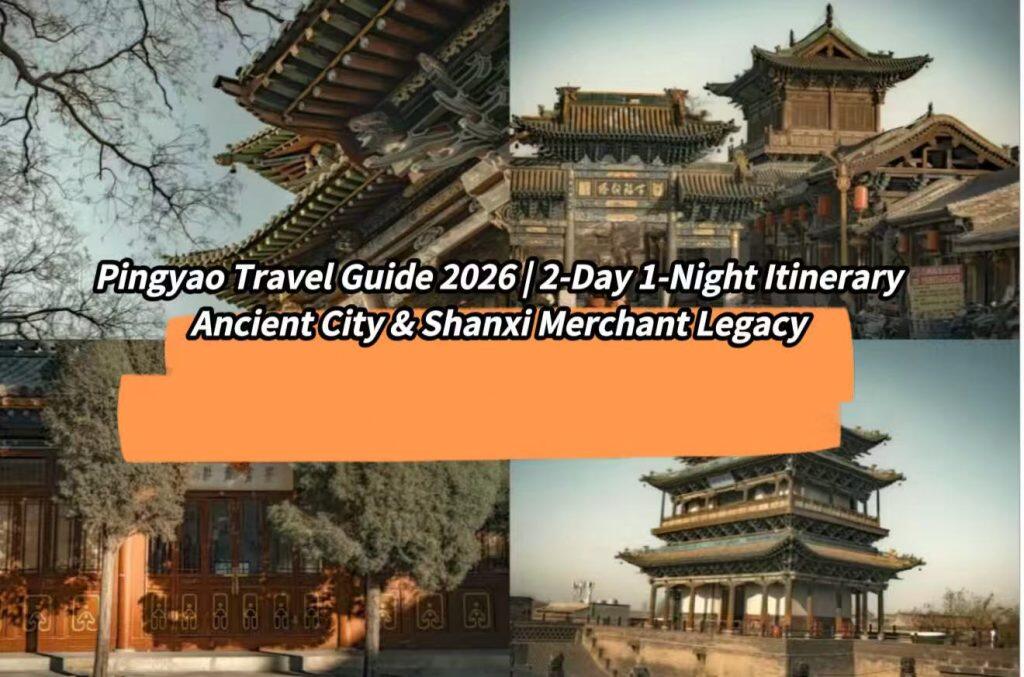
Hey everyone, Mia Chen here — your reliable China travel insider with years of on-the-ground experience hosting international guests. I don’t do rushed check-in tours. I specialize in slow, cultural-focused travel that lets visitors truly feel the soul of ancient Chinese towns. Among all the historic destinations I’ve explored, Pingyao always stands out. Unlike overly commercial ancient towns, it preserves real Ming and Qing city walls, original courtyard residences, and the legendary Shanxi merchant financial culture that once shaped ancient China’s economy.
No crowded sightseeing, no fake street scenes — just genuine old-town charm. I’ll walk you through a relaxed 2-day 1-night Pingyao itinerary, where you can wander ancient alleys, explore century-old draft banks, taste local authentic flavors, and experience the quiet, timeless lifestyle of a living UNESCO ancient city.
Pre-Travel Preparation
This chapter filters out trivial daily travel information and only reserves must-know cross-border travel preparation items for foreign visitors, covering documents, network payment, cultural etiquette and seasonal dressing, solving the core pain points of overseas travelers visiting small ancient towns in China.
Documents & Ticket Rules
All foreign visitors need to carry a valid passport and Chinese visa for entry. It is recommended to store both physical copies and electronic backup files of passport and visa, as all core scenic spots in Pingyao implement real-name ticket checking. The most practical ticket for foreign tourists is the Pingyao Ancient City Combo Ticket (125 RMB), which is valid for 3 consecutive days and covers 22 core scenic spots including ancient city walls, Rishengchang Draft Bank, Pingyao County Government and ancient courtyard clusters. The ancient city street area is free to open, and no separate ticket is required for casual walking. There is no bargaining for official scenic spot tickets, and foreign travelers can book tickets through official tourist platforms with passports.
Network & Payment Adaptation
Pingyao’s daily consumption fully relies on mobile payment (WeChat Pay/Alipay), and cash and international credit cards are rarely accepted in small shops, snack stalls and ancient homestays. Foreign travelers need to bind international bank cards to Chinese mobile payment platforms in advance. It is necessary to prepare a China local SIM card or portable WiFi before traveling, as remote ancient town areas have unstable roaming network signals. Download offline Chinese-English translation software in advance, because most local shop owners and residents cannot speak English, and only star hotels and scenic spot service centers provide basic English services.
Cultural Visiting Etiquette & Dressing Tips
Pingyao is a living ancient town with intact historical relics, not a recreational commercial scenic area. Foreign travelers need to abide by cultural protection rules: do not carve or touch ancient city walls and wooden buildings, do not trample on ancient roof tiles, and keep quiet in ancient government offices and religious venues to respect traditional Chinese culture and historical relics. For dressing, spring and autumn require thin coats for temperature difference adaptation; summer is cool and suitable for casual walking clothes; winter is dry and cold, needing warm down jackets. Comfortable walking shoes are essential for the whole journey, as the ancient city is paved with bluestone roads, which are not suitable for high heels and hard-soled shoes.

Detailed 2-Day 1-Night Cultural Itinerary
Day 1: Arrival + Ancient City Core Relics Exploration & Night Culture Experience
Arrival & Check-in (14:00-15:30)
Arrive at Pingyao Railway Station or Pingyao Ancient City High-speed Railway Station. Take a regular taxi or online car-hailing (supporting English positioning) to the ancient city gate. After arriving, contact the homestay staff to complete luggage transfer and check-in. Settle down and adapt to the ancient town’s slow pace, and briefly understand the ancient city’s layout and travel precautions.
Ancient City Wall + Rishengchang Draft Bank (15:30-18:30)
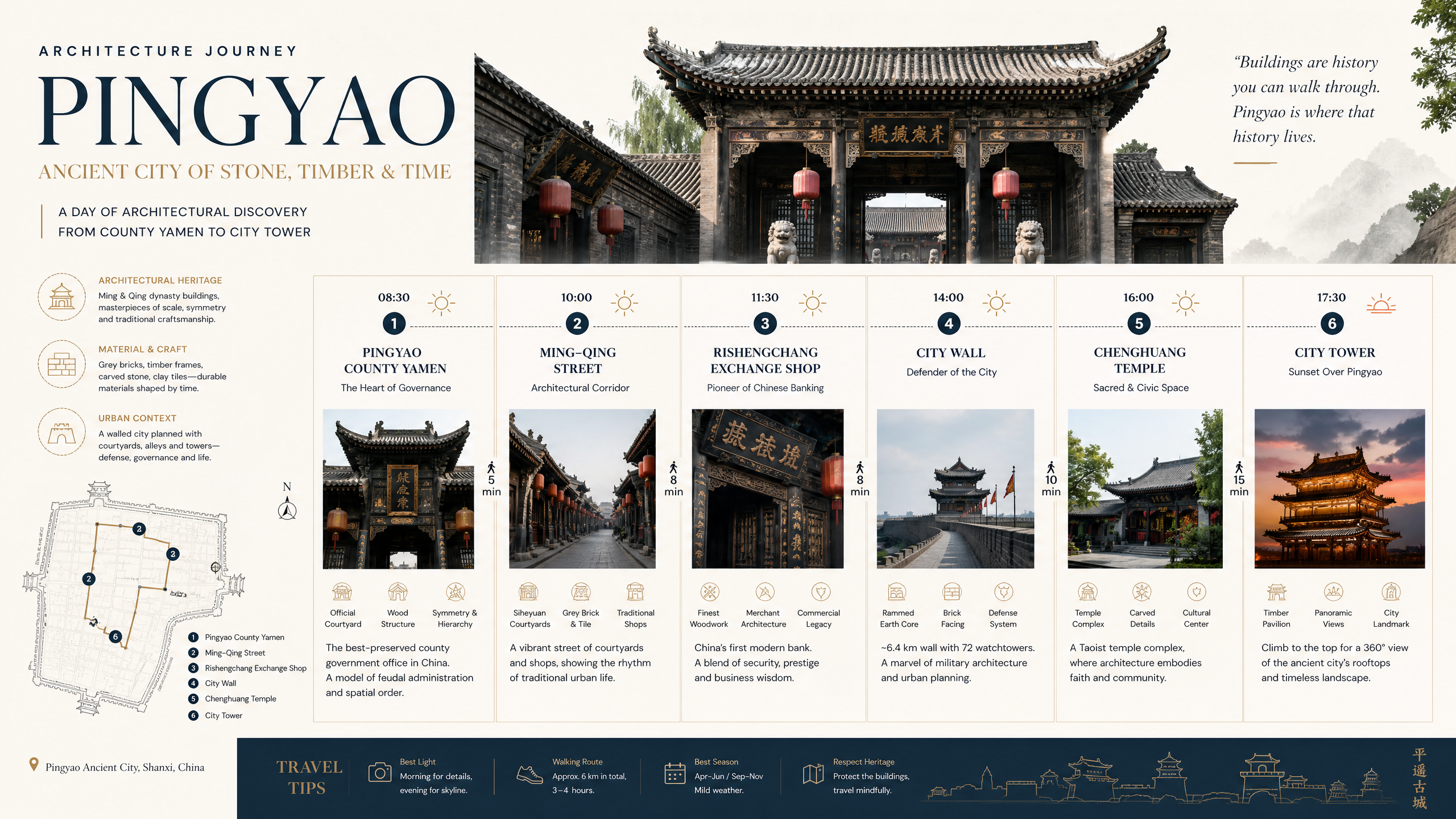
Start with the most representative Pingyao Ancient City Wall, the core landmark of the World Heritage Site. Built in the Ming Dynasty, the 6.4-kilometer ancient city wall is completely preserved, which is rare in China. Walking on the bluestone city wall, you can overlook the whole picture of the ancient city’s gray tiles and black bricks, and feel the grand layout of ancient county cities. The wall retains ancient crenellations, watchtowers and defense facilities, reflecting the ancient Chinese city defense system and architectural wisdom.
Then visit Rishengchang Draft Bank, known as the originator of modern Chinese banking. Founded in the Qing Dynasty, it is the first professional draft bank in Chinese history, creating the ancient bill remittance system that replaced silver cash transactions. Foreign travelers can visit ancient office halls, account rooms and customer reception areas, and understand the business operation mode, credit system and risk control means of ancient Shanxi merchants. The scenic area is equipped with English introduction boards, which can help overseas tourists sort out the development context of ancient Chinese financial civilization.
Ming and Qing Street Night Tour + Local Dinner (18:30-21:30)
Dine at a local time-honored restaurant to taste signature Pingyao beef and authentic Shanxi pasta, experiencing the characteristics of northern folk diet. After dinner, stroll along Ming and Qing Ancient Street, the most prosperous core street of Pingyao Ancient City. At night, the red lanterns on both sides of the street are lit up, restoring the bustling street scene of the ancient merchant city. There are traditional intangible cultural heritage performances such as shadow puppetry and paper cutting on the street. Foreign travelers can watch folk performances up close and experience the lively folk culture of northern China.
If time permits, you can watch the immersive live show See You Again, Pingyao, which takes the Shanxi merchant’s loyalty, righteousness and family feelings as the core, showing the profound humanistic heritage of Pingyao, bringing a shocking cultural experience.

Day 2: Official Culture & Folk Architecture In-Depth Tour + Departure
Pingyao County Government + Ancient City Tower (08:30-11:30)
Visit Pingyao County Government Office, the best-preserved ancient county government office in China, known as the “ancient county government museum”. It completely retains the official layout and functional divisions of the Ming and Qing dynasties, including the trial hall, official residence and patrol institution. Foreign travelers can watch the simulated ancient county magistrate court trial performance at fixed time, intuitively understanding the ancient Chinese grassroots political system, judicial trial process and official management culture.
Then climb Ancient City Tower, the central landmark of Pingyao Ancient City, standing at the geometric center of the ancient city. It is the highest viewing point in the urban area, where you can have a panoramic view of the regular and neat layout of the ancient city’s streets and courtyards, and deeply appreciate the rigorous urban planning concept of ancient Chinese cities.
Authentic Folk Lunch (11:30-13:00)
Taste local characteristic snacks such as Pingyao Wantuo and fried noodles at an old folk restaurant, experience the most authentic daily diet of local residents, and feel the simple and down-to-earth northern folk customs.
Compound Architecture Visit & Departure (13:00-16:00)
Visit the well-preserved ancient courtyard clusters in the ancient city, focusing on appreciating the three major architectural crafts of brick carving, wood carving and stone carving in northern ancient courtyards. These exquisite carvings contain traditional Chinese auspicious patterns, moral culture and aesthetic concepts, which are precious materials for understanding ancient northern architectural art. You can also experience intangible cultural heritage projects such as local paper-cutting and dough figurine making, and interact with folk craftsmen to feel the charm of traditional Chinese folk art.
After the in-depth cultural tour, return to the homestay to pack luggage, check out, and take a regular vehicle to the high-speed railway station or railway station to end the trip.
Foreigner-Friendly Accommodation Recommendation
Abandon over-commercialized homestays with no service guarantee. This chapter selects safe, clean, English-service supported and culturally distinctive courtyard homestays exclusive for foreign travelers, all located in the core area of the ancient city with superior locations, avoiding noisy peripheral streets and remote accommodation areas.
Core Accommodation Area: Inside Pingyao Ancient City
It is strongly recommended to stay inside the ancient city. Only by living in a traditional quadrangle courtyard homestay can foreign travelers truly experience the living aesthetics of Ming and Qing ancient towns. The core accommodation area is centered on South Street and North Street, with concentrated catering and scenic spots, walking distance to all core attractions, no need for daily commuting by car, and quiet night environment with strong ancient charm. Most homestays here provide 24-hour front desk service, simple English reception, free luggage storage and pick-up service, which is very friendly to overseas tourists.
High-Quality Homestay Options (Cultural Experience Focused)
High-end Courtyard Homestay: Retaining authentic Ming and Qing wooden structure architecture, with traditional carved windows, brick carvings and courtyard layout, equipped with modern sanitary ware, constant temperature air conditioning and sound insulation facilities. The homestay owner can introduce the architectural culture of ancient Shanxi courtyards in simple English, providing a pure ancient town dwelling experience. The price ranges from 400 to 800 RMB per night, suitable for travelers pursuing cultural experience and accommodation comfort.
Cost-Effective Boutique Homestay: Standard clean rooms, complete supporting facilities, located in the quiet alley of the ancient city, far from the noisy commercial streets. The price is 180 to 350 RMB per night, with standardized service, suitable for backpackers and cultural sightseeing travelers with limited budget.
Foreign Traveler Exclusive Tip: Motor vehicles are prohibited in the core area of the ancient city. After arriving at the ancient city gate, the homestay will provide free luggage cart transfer service, so there is no need to worry about walking with luggage.
Authentic Local Catering Guide
Pingyao’s catering is typical of Shanxi Central Plains flavor, mainly pasta-based, with mild and mellow taste, less spicy, very suitable for foreign taste buds. This chapter recommends time-honored local restaurants and signature dishes with cultural connotations, avoiding tourist trap restaurants with high prices and poor taste, focusing on letting overseas travelers taste authentic folk food and understand Shanxi food culture.
Must-Try Signature Local Dishes
Pingyao Beef: A national intangible cultural heritage and the most representative specialty of Pingyao, with a production history of more than 300 years. The beef is tender, fat but not greasy, with rich sauce flavor. It can be eaten cold or heated, with unique taste. In ancient times, it was the necessary dry food for Shanxi merchants to travel far and do business, carrying the tough business spirit of ancient merchants.
Pingyao Wantuo: A classic folk pasta snack with a chewy and smooth taste. It can be mixed with sauce or stir-fried, with fresh and mild flavor. It is a daily staple food of local people and the most approachable traditional snack for foreign tourists.
Daoxiao Noodles (Shanxi Knife-Shaved Noodles): One of China’s four major noodle types, with thin, smooth and chewy noodles. Paired with mushroom and meat sauce, the taste is rich and layered, representing the essence of northern Chinese pasta culture.
Yuan’an Porridge: A traditional ancient town health porridge, cooked with millet and miscellaneous grains, with a delicate and sweet taste, suitable for relieving greasy food and adapting to local diet.
Authentic Time-Honored Restaurant Recommendations
Old Pingyao Restaurant: A century-old local time-honored brand, specializing in authentic Pingyao beef and traditional Shanxi pasta. The restaurant has simple English menu labels, transparent pricing, standardized portions, and locals often dine here. It is the first choice for foreign travelers to experience authentic local food.
Ancient City Folk Snack House: Hidden in the ancient city alley, focusing on folk snacks, with affordable prices and diverse tastes. It provides one-stop tasting of Wantuo, knife-shaved noodles and fried local specialties, with no excessive commercial decoration and pure local flavor.
Catering Tip for Foreigners: Most scenic spot peripheral restaurants have exaggerated pricing and mediocre taste. It is recommended to choose restaurants in the ancient city’s residential alleys, with more authentic flavor and higher cost performance. Local staple food is mainly pasta, and vegetable dishes are relatively few, which is the characteristic of northern Shanxi diet.
Full-Route Transportation Guide for Foreign Travelers
Arrival & Departure Transportation
High-speed Railway: Pingyao Ancient City High-speed Railway Station is the main transportation hub for foreign tourists. It has direct high-speed trains from major cities such as Beijing, Xi’an and Luoyang, with fast and convenient travel. The station has standardized online car-hailing and taxi pick-up areas, with clear English road signs and unified charging standards.
Ordinary Railway: Pingyao Railway Station is close to the ancient city, suitable for tourists taking ordinary trains. The supporting transportation is complete, and it is only a 10-minute drive from the ancient city core area.
Intra-City & Scenic Spot Transportation
The core area of Pingyao Ancient City is a pedestrian-only zone with no motor vehicles allowed. All scenic spots are within walking distance, and walking is the best way to experience the ancient city’s charm. For fatigue relief, you can take a formal ancient city rickshaw with unified pricing and regular drivers, which is also a characteristic ancient town travel experience.
There is no complex bus system in the ancient city, and public transportation is not required for the whole journey. Avoid taking unlicensed black cars soliciting passengers at the station entrance to prevent fraud and arbitrary charges.
Exclusive Overseas Traveler Tips
Ticket & Visiting Rules
The Pingyao Ancient City combo ticket is valid for 3 days, allowing multiple visits to various scenic spots. All single scenic spots do not support separate ticket sales. The opening hours of indoor scenic spots are 8:00 AM to 5:30 PM, and the ancient city streets are open all day. It is recommended to visit cultural relic scenic spots during the day for clear viewing and convenient cultural explanation, and stroll the streets at night to enjoy the night scenery.
Language & Communication Tips
Pingyao is a small ancient town with limited international service resources. Only star hotels, scenic spot service centers and formal restaurants have basic English guidance and simple English communication. Most local vendors, residents and small shop owners only speak Chinese. It is necessary to rely on real-time translation software for daily communication. It is recommended to save the English names and addresses of scenic spots and accommodation in advance to avoid communication barriers.
Unique Cultural Experience Value
Different from most commercial ancient towns in China that focus on shopping and entertainment, Pingyao’s core travel value lies in authentic historical inheritance. It is a living ancient city that integrates ancient architecture, financial history, official culture and merchant spirit. Foreign travelers can systematically understand the development of China’s ancient financial industry, the operation mode of grassroots political power in feudal dynasties, and the business ethics of Shanxi merchants here. These in-depth historical and cultural experiences cannot be obtained in modern urban scenic spots.
Safety & Emergency Guidelines
Pingyao Ancient City has a simple folk custom and a safe public security environment, with patrol staff on duty in the scenic area all day long. China’s emergency numbers 110 (police) and 120 (ambulance) support basic English emergency services. The bluestone roads in the ancient city are slippery in rainy days, so please walk carefully. Avoid staying alone in remote alleys late at night to ensure travel safety.

Mia Chen
Mia Chen is a 30‑year‑old tour guide. She has explored the ancient city thoroughly
and hosted many international visitors. She is passionate and knowledgeable about
Pingyao’s UNESCO heritage and Shanxi merchant culture, enriching every tour
with her down‑to‑earth, firsthand local insights.