
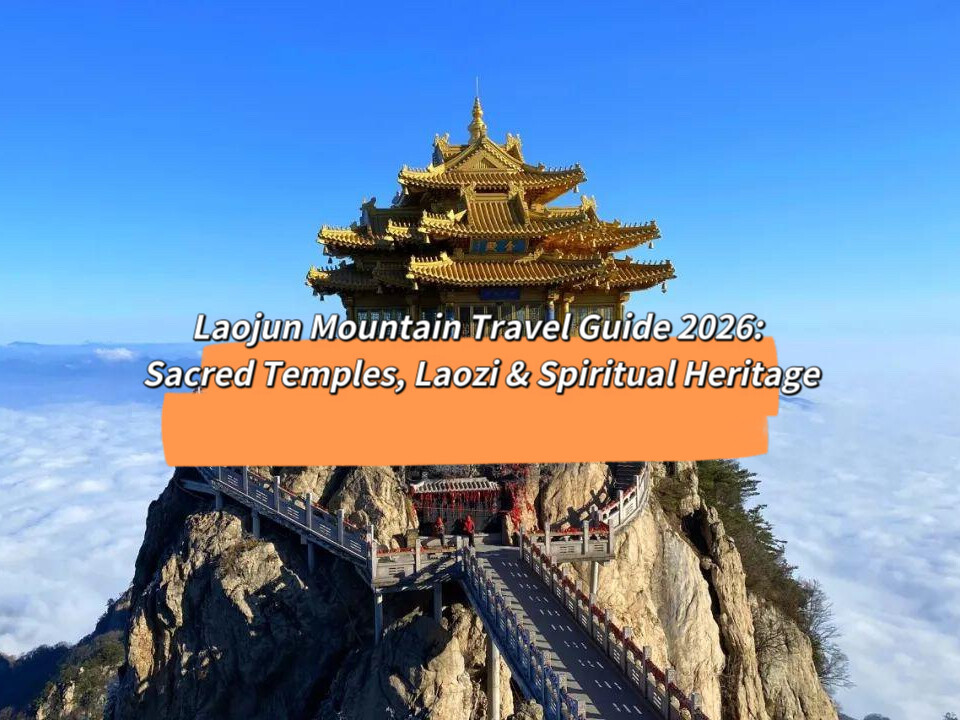
Hello, I‘m Mike Wang. For over 20 years, I have guided travelers through China’s most breathtaking landscapes, but few places have left me as speechless as Laojun Mountain. I still remember my first visit — standing on the Golden Summit as the sunrise broke through the clouds, illuminating the golden temple roofs like something from a celestial painting. I knew right then that this wasn‘t just a mountain; it was a living piece of Chinese mythology.
Located in Luanchuan County, Luoyang City, Henan Province, Laojun Mountain is the main peak of the Funiu Mountains, soaring to 2,217 meters above sea level. It is known as the “Unparalleled Sacred Realm in the World, the Number One Immortal Mountain”. This is the place where Laozi — the ancient philosopher and founder of Taoism — retreated to cultivate and write the Tao Te Ching. Emperor Taizong of the Tang Dynasty personally bestowed the name Laojun Mountain in 637 AD. Today, it is a national 5A-level tourist attraction, a world geological park, and a sacred pilgrimage site for Taoist believers across northern China.
If you are planning your Luoyang trip 2026, this Laojun Mountain travel guide 2026 will give you everything you need — from the must-see Golden Summit to the best routes, tickets, and local secrets that only a guide of two decades would know.
🏔️ Why Laojun Mountain 2026 Deserves a Spot on Your China Bucket List
You might be thinking, “Another mountain in China?” But Laojun Mountain is different.
First, the geology is spectacular. Formed by continental orogeny 1.9 billion years ago, the mountain features unique quartzite peak forests that erupt from the ground in jagged formations resembling petrified waterfalls. These “granite sea forests” transform throughout the day — at dawn, they appear as dark silhouettes against cascading clouds; by midday, sunlight reveals their rose-gold veins; at sunset, the entire range glows like smoldering embers.
Second, the cultural heritage is profound. This isn‘t just a pretty mountain — it’s a millennium-old Taoist sacred site. The Golden Summit Taoist temples, perched on the peaks at 2,217 meters, include the Golden Hall, Jade Emperor Peak, and Bright Treasure Platform, forming a celestial triad representing Taoism‘s highest deities. The layout of the mountain mirrors Taoist cosmology — winding paths reflect the meandering flow of Tao, and the temples crown the summits like a heavenly palace.
Third, the views are otherworldly. The sea of clouds that regularly submerges the valleys leaves only the highest peaks visible like islands in a white sea. Sunrise and sunset at the Golden Summit are nothing short of divine — the golden sunlight bathing the ancient buildings and cliffs crafts mystical views that have inspired poets and philosophers for centuries.
I‘ve taken guests from all over the world to this mountain, and the reaction is always the same: silence, followed by a deep exhale. This place touches something primal and spiritual in every visitor.
🎟️ Tickets, Hours & Smart Booking for Laojun Mountain 2026
💰 Ticket Prices (2026 Update):
⏰ Opening Hours:
- Scenic Area: 24 hours, open year-round
- Cable car upward operation: 7:30 AM – 3:30 PM
- Cable car downward operation: Until approximately 7:30 PM
💡 Golden Summit Lighting:
The Golden Summit Taoist temples are illuminated daily around 5:30 PM – 7:00 PM (times vary by season). This is one of the most magical moments — watching the golden roofs glow against the darkening sky. I always tell my guests: don‘t miss the lighting show.
⚠️ 2026 Special Offer:
From June 10 to July 31, 2026, the mountain is offering free admission to all 2026 national high school and college graduates. If you qualify, don‘t miss this incredible opportunity!
🚡 Mastering the Cable Cars: Your Key to an Effortless Ascent
Let me be brutally honest with you: this mountain is high and steep. I’ve seen travelers try to hike the whole way, and they arrive at the summit exhausted, miserable, and unable to enjoy the views. Don‘t be that person.
The smart way to experience Laojun Mountain is to use the two-level cable car system.
🚠 Level 1 Cable Car (Zhongling / Yunjing) – Absolutely Non-Negotiable
You must take this cable car. The walk from the ticket center to the cable car entrance alone is 7 kilometers of winding mountain roads with no scenic views — that‘s 4 hours of walking for absolutely nothing. The Level 1 cable car saves you 3-4 hours of exhausting climbing. It‘s 130 RMB round trip, and it is the best money you will spend all day.
Pro tip: If you‘re driving, navigate directly to “Laojun Mountain Yunjing Cableway” or “Parking Lot No. 13″ — do NOT park at the ticket center. Parking Lot 13 is right next to the cableway entrance.
🚠 Level 2 Cable Car (Peak Forest) – Optional, But Recommended
The Level 2 cable car takes you from Zhongtian Gate up to the Peak Forest area, near the start of the Ten-Mile Painted Screen. It costs 80 RMB round trip. I recommend taking it unless you‘re an experienced hiker who wants to enjoy the mountain trail. Even with both cable cars, you‘ll still do about 20-30 minutes of walking to reach the Golden Summit.
⏱️ Time to Summit (2026 Updated)
| Route | Time | Effort Level |
|---|---|---|
| Full hike (no cable cars) | 5-6 hours | Extremely demanding |
| Level 1 cable car + hike | 2.5-3 hours | Moderate |
| Both cable cars + short hike | 1.5-2 hours | Easy — recommended |
🏯 The Main Attractions: What to See on Laojun Mountain 2026
✨ Golden Summit Taoist Temples – The Soul of Laojun Mountain
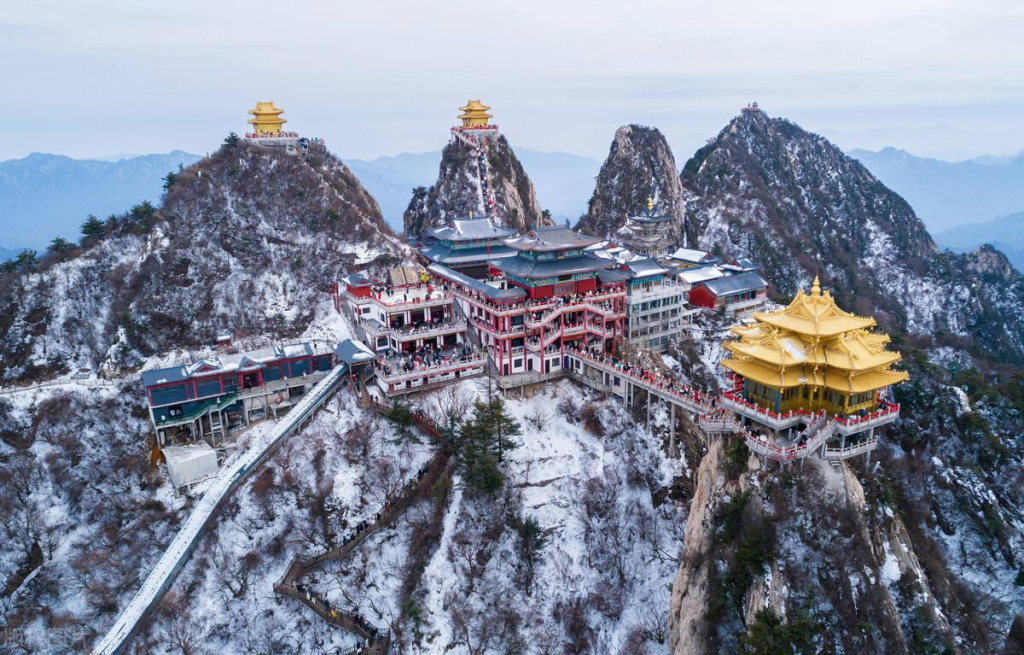
This is what you came for. Perched at 2,217 meters, the Golden Summit Taoist temple complex is the highest point on the mountain. It includes the Golden Hall (Daode Mansion), Bright Treasure Platform (Liangbao Terrace), and Jade Emperor Peak (Yuhuangding).
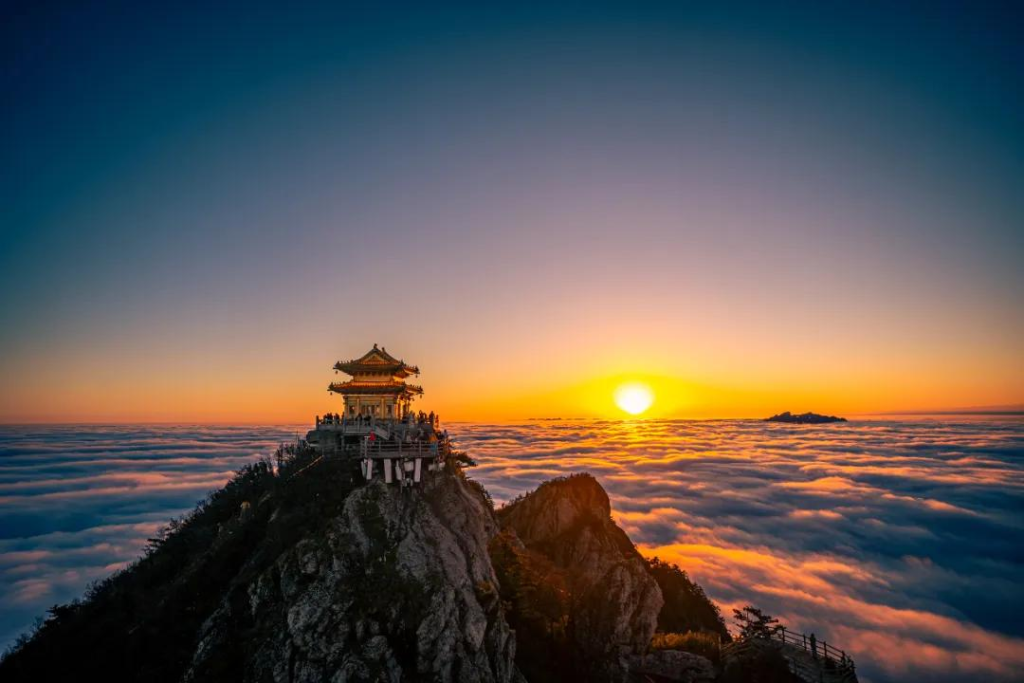
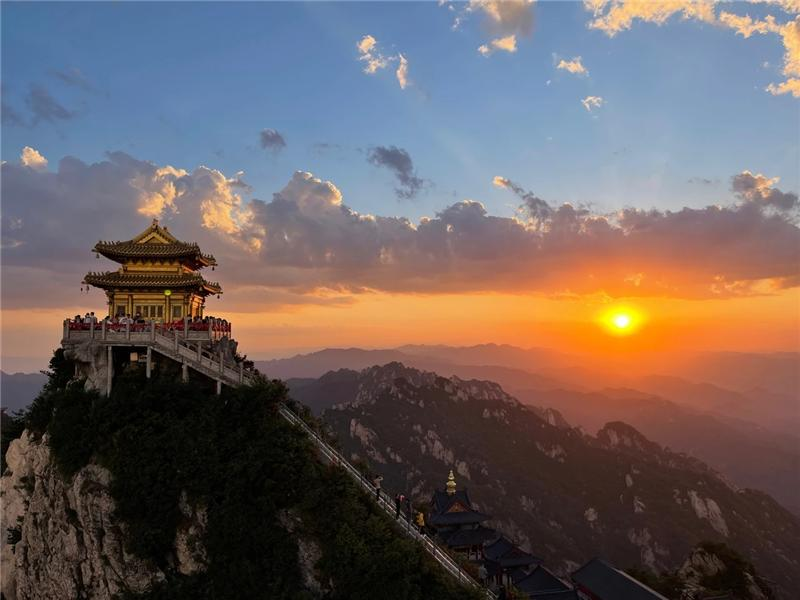
The temples appear faintly in the mist, their golden roofs gleaming like a heavenly palace. At sunrise (5:30-6:30 AM) and sunset (6:30-7:00 PM), the rosy clouds gild the golden halls, creating a scene so beautiful it feels unreal.
My personal recommendation: Visit in the late afternoon. Watch the sunset from the Golden Summit, then stay for the lighting show around 5:30-7:00 PM. The temples illuminated against the darkening sky is one of the most magical experiences I have ever witnessed in all of China.
🖼️ Ten-Mile Painted Screen – A Walk Through a Living Painting
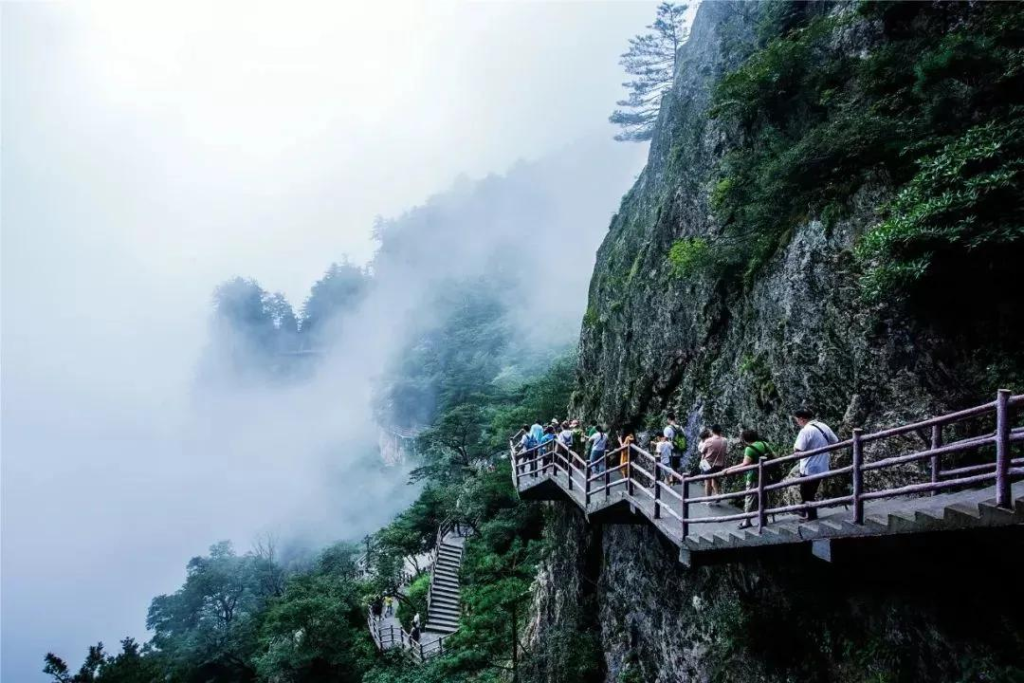
The Ten-Mile Painted Screen (Shili Huaping) is the core highlight of Laojun Mountain. This is a cliffside plank road that winds through the karst peak forest, offering stunning views at every turn. Walking through takes about 1.5 to 2.5 hours, and every step feels like walking through a classical Chinese landscape painting. The peaks are densely clustered, and every photo looks like a masterpiece.
Insider tip: Walk the trail clockwise — go through the Wonderland Tunnel first, then the Painted Screen, and don‘t turn back. And don‘t enter the tunnel shortcut — the mountain trail is the highlight.
🏔️ Mazong Ridge – The Best Sunrise & Sunset Spot
At about 2,217 meters, Mazong Ridge offers the most open views of the Golden Summit and surrounding peaks. This is the premier spot for watching sunrise and sea of clouds. The sunrise viewing platform at Golden Summit becomes a nonsectarian altar at dawn, where travelers from all nations stand hushed as crimson light spills across the peaks.
Photographer‘s tip: Bring a wide-angle lens and a lightweight tripod. The combination of sea of clouds, sunrise, and the Golden Summit is what photographers call a “seal-the-deal” moment.
⛩️ South Heavenly Gate – The Gateway to the Summit
The South Heavenly Gate (Nantianmen) is the iconic checkpoint before the summit — a stone archway that feels like stepping into the celestial realm. Pass through it, and you‘re moments away from the Golden Summit.
🏛️ Laojun Temple – The Ancestral Home of Taoism
Built during the Northern Wei Dynasty and rebuilt under Emperor Taizong of the Tang Dynasty, Laojun Temple is the oldest and most significant Taoist structure on the mountain. The incense smoke, green tiles, and red walls reflect ancient cypresses and pines. The morning bells and evening drums blend with the mountain breeze, conveying a calming power that has drawn pilgrims for over 1,500 years.
🗺️ Sample Itineraries for Laojun Mountain 2026
🌅 One-Day Easy Tour (Recommended for most visitors)
Total time: Approximately 5 hours
Route: Visitor Center → Level 1 Cable Car (Zhongling/Yunjing) → Zhongtian Gate → Level 2 Cable Car (Peak Forest) → Ten-Mile Painted Screen → South Heavenly Gate → Golden Summit Taoist Temples → Return via cable cars
This route is time-saving and effortless. It covers all the core highlights without exhausting you. I recommend this for most travelers, families with children, and anyone who wants to actually enjoy the views instead of gasping for breath.
🏕️ Two-Day Immersion (For sunrise and sunset chasers)
Day 1: Ascend in the afternoon, watch the sunset from the Golden Summit, see the lighting show, and stay overnight at the summit
Day 2: Wake early for sunrise and sea of clouds, then descend to explore Dream Chasing Valley or Zhaigou
🥾 Hiking Deep Tour (For fitness enthusiasts)
Route: Level 1 cable car → Zhongtian Gate → hike → Ten-Mile Painted Screen (2.5 hours) → Golden Summit
Total time: Approximately 7 hours
Suitable for physically fit visitors who enjoy hiking. The mountain trail from Zhongtian Gate to the summit has about 8,000 steps.
🚗 How to Get to Laojun Mountain 2026
🚄 High-Speed Train + Bus (Recommended):
- Take the high-speed train to Luoyang Longmen Station
- Transfer to the Luanchuan tourist shuttle bus — the ride takes about 2.5 hours and costs around 55 RMB
- The bus drops you at the scenic area entrance
🚗 Self-Driving:
- Navigate to “Laojun Mountain Yunjing Cableway” or “Laojun Mountain Zhongling Cableway”
- From Zhengzhou or Luoyang, take the Luoluan Expressway — about 2.5 hours
- Crucial: Do NOT park at the ticket center. Drive directly to the cableway entrance
- Parking fee: 10 RMB/day
🚌 From Luoyang City:
- Luoyang Longmen Station has a direct bus to Laojun Mountain
- Alternatively, join a one-day tour from Luoyang — the tour bus drops you directly at the cableway entrance, saving you the hassle of shuttle buses. Tickets + round-trip bus + first-level cableway cost about 268 RMB
💡 Local Expert Tips for Laojun Mountain 2026
After 20 years, here are my golden rules:
- Take the Level 1 cable car. Non-negotiable. The walk up is 7 km of winding roads with zero views.
- Buy tickets online in advance. The scenic area limits daily visitors. Enter with your ID card — no queue.
- Avoid weekends and public holidays. Weekdays offer a much better experience. National holidays like May Day and National Day are absolute chaos.
- Dress in layers. The temperature difference between the base and summit can exceed 15°C. Even in summer, bring a windbreaker. In winter, you‘ll need a thick down jacket and crampons (anti-slip shoe spikes).
- Bring your own water and snacks. Prices on the mountain are high. But if you forget, instant noodles are available for 12 RMB.
- Buy hiking poles at the foot. Two bamboo sticks cost just 5 RMB. They can literally save your legs.
- Don‘t bring your own instant noodles. There‘s no free hot water on the mountain.
- Cable car upward stops at 3:30 PM. Plan your descent accordingly.
- The best time for sea of clouds is after rain — the humidity creates the most dramatic cloud formations.
- The best months to visit are April-May and September-October — pleasant weather and high cloud-sea probability. Winter offers stunning snow-covered Golden Summits. Summer is a cool escape at just 22°C at the summit.
❓ FAQ – Laojun Mountain Trip 2026
Q: Is Laojun Mountain worth visiting if I‘m not interested in Taoism?
A: Absolutely — and I say this as someone who has taken hundreds of guests here. While the Taoist heritage is profound and adds a rich layer of meaning, Laojun Mountain‘s natural beauty stands entirely on its own. The 1.9-billion-year-old quartzite peak forests, the dramatic sea of clouds that regularly submerges the valleys, the cliffside plank roads winding through granite pillars — these are geological wonders that would impress anyone, regardless of their spiritual beliefs. I‘ve taken photographers, families, adventure travelers, and history buffs here, and every single one of them left in awe. The Golden Summit at sunrise or sunset is simply one of the most beautiful sights I have ever seen in all of China — and I‘ve been doing this for 20 years.
Q: Can I visit Laojun Mountain as a day trip from Luoyang?
A: Yes, absolutely — and it‘s one of the most popular day trips from Luoyang. The direct bus from Luoyang Longmen Station takes about 2.5 hours. If you take both cable cars, you can complete the core route — Ten-Mile Painted Screen and Golden Summit — in about 5 hours. I recommend starting early (around 7-8 AM) to give yourself plenty of time. However, if you want to experience both sunset and sunrise, you‘ll need to stay overnight. The summit accommodation is basic but the experience is unforgettable. For most travelers, a one-day trip with both cable cars is perfectly sufficient and incredibly rewarding.
Q: Is Laojun Mountain suitable for elderly visitors or families with young children?
A: Yes — if you take the cable cars. The two-level cable car system makes this mountain accessible to almost everyone. With both cable cars, you only need to walk about 20-30 minutes to reach the Golden Summit. The Ten-Mile Painted Screen plank road is mostly flat and easy to walk. Children under 12 or under 1.4 meters enter for free, and seniors over 60 get half-price admission. That said, the summit is at 2,217 meters, so anyone with serious mobility issues should assess their ability carefully. The mountain also offers sedan chair services for those who need assistance.
Q: What‘s the best month to visit Laojun Mountain in 2026 for the sea of clouds?
A: For the highest probability of sea of clouds, I recommend April-May and September-October. These months offer stable weather and ideal humidity levels for cloud formation. The absolute best time to see sea of clouds is early morning after rain — the rain increases humidity, and as the sun rises, the clouds roll in like a white ocean. March is also frequently mentioned by locals as a prime month for cloud-sea photography. Winter (December-February) offers a different kind of beauty — the Golden Summit covered in snow and ice looks like a heavenly palace, though temperatures can drop to -15°C at the summit. Summer (June-August) is a cool escape at just 22°C, but can be rainy and foggy.
Laojun Mountain is more than a tourist destination — it is a place of transformation. I have watched hardened business travelers break down in tears at the beauty of a sunrise over the Golden Summit. I have seen families reconnect while walking the Ten-Mile Painted Screen together. I have felt the profound silence of the mountain at dusk, when the temple bells ring and the clouds roll past like a white ocean.
This mountain has been a sacred site for over 1,500 years. Laozi himself walked these paths, meditated on these peaks, and wrote words that would shape the spiritual destiny of a civilization. When you stand on the Golden Summit, you are standing in the footsteps of a philosopher whose ideas have influenced billions of people over millennia.
I sincerely invite you to come to Luoyang and experience Laojun Mountain in 2026. Ride the cable cars through the clouds, walk the cliffside plank roads, watch the sunset paint the golden temples in shades of amber and rose, and let the sea of clouds wash away the noise of the modern world. This is a place that will change you — I promise you that.
If you need any local advice — where to find the best Luanchuan tofu soup, how to navigate the cable car queues, or which summit viewpoint offers the most dramatic sunrise — just ask. I am always happy to share my home with you. Safe travels, and I hope to see you on the mountain.

Mike Wang
Mike Wang is a 40-something Chinese travel expert, has explored the world,
hosting numerous foreign visitors. He’s deeply interested in and knowledgeable
about ancient cultural architectures, enriching journeys with his insights.
Essential China Attractions
Zhangjiajie Travel Guide 2026: Complete Guide to China’s Most Spectacular Natural Wonder
Jiuzhaigou Travel Guide 2026: Complete Guide to China’s Fairyland
Huangshan Travel Guide 2026: Yellow Mountain Complete Guide
Yangshuo Guangxi 2026 | Karst Mountains & Li River Paradise
Potala Palace Travel Guide 2026: Lhasa’s Iconic Tibet Landmark & Top Attractions
Suzhou Classical Gardens 2026 | UNESCO World Heritage Guide
Dunhuang Mogao Caves Travel Guide 2026: Complete Visitor’s Manual
Zhangye Danxia Travel Guide 2026 | China’s Rainbow Hills
Lijiang Ancient Town 2026 | UNESCO Naxi Cultural Gem Guide
Qinghai Lake Travel Guide 2026: China’s Largest Salt Lake – Complete Local Tips
Xishuangbanna Travel Guide 2026 | Borderland Tropical Paradise China Summer Escape Pick
2026 Wuzhen Trip – East & West Gate Iconic Yangtze Delta China Attraction
2026 Shaolin Temple Trip – World-Famous Zen Temple Top China Attraction
Hukou Waterfall Travel Guide 2026 | Yellow River’s Grand Roaring Falls Guide
Changbai Mountain Tianchi Travel Guide2026 | China’s Volcanic Alpine Lake Guide
Danxiashan Travel Guide 2026 | China’s Colorful Danxia Landform Gem Guide
Fujian Tulou Travel Guide 2026 | UNESCO Ancient Hakka Earthen Building Guide
| Updated: July 15, 2026Popular City Travel Guides
Beijing Travel Guide Shanghai Travel Guide Hangzhou Travel Guide Sanya Travel Guide Chongqing Travel Guide
Nanjing Travel Guide Guangzhou Travel Guide ChengduTravel Guide Hongkong Travel Guide Xi’an Travel Guide