Hi, I’m Lila Jiang, a China travel professional with over 5 years of experience. During these five years, I’ve traveled extensively around China.Planning to explore Beijing by subway? The Beijing Metro Map is one of the most useful tools you can have during your trip.
Beijing has one of the world’s largest urban rail transit networks, connecting major attractions, railway stations, airports, shopping districts, business areas, and residential neighborhoods across the city. For international travelers, the subway is often the fastest and most affordable way to get around Beijing, especially during busy traffic hours.
In this updated Beijing Metro Guide 2026, you’ll learn how to read the Beijing subway map, which metro lines are most useful for tourists, how much Beijing subway tickets cost, how to pay with international bank cards, and how to reach popular attractions such as the Forbidden City, Temple of Heaven, Summer Palace, and Olympic Park.
Beijing Metro Map 2026: Quick Overview
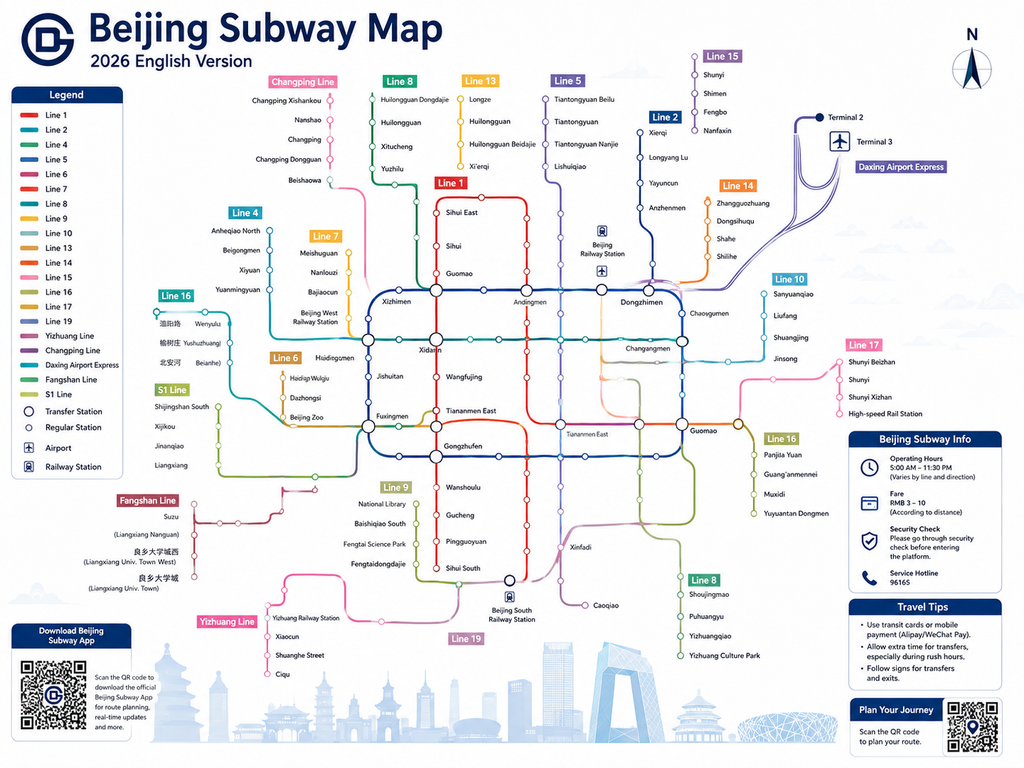
Beijing’s subway network continues to expand rapidly. By the beginning of 2026, Beijing’s operational subway network had reached approximately 909 kilometers, making it the longest urban rail transit network in China. Three new lines or extensions entered operation in late 2025, while further expansion projects are planned for 2026.
For tourists, however, you don’t need to memorize the entire network.
The most important thing is to understand the major lines connecting central Beijing with the city’s top attractions and transportation hubs.
Beijing Subway at a Glance
- Network: More than 900 km of operational subway tracks
- Fare: From CNY 3 on the standard urban subway network
- Fare system: Distance-based
- Airport Express: Separate fare system
- Payment: International bank cards, transit cards, QR-code options, single-journey tickets and other approved payment methods
- Languages: Chinese and English signs are widely available
- Best for: Beijing attractions, railway stations, airports and major shopping areas
Because individual subway lines have different operating schedules, always check the latest station information or the official Beijing Subway app before making a late-night journey.
Why Take the Beijing Subway?
Beijing is a huge city, and famous attractions can be surprisingly far apart.
During weekday mornings and evenings, road traffic can become heavy. The subway is therefore one of the easiest ways for visitors to move around the city without worrying about traffic jams.
There are several advantages:
1. It is affordable
Standard subway fares start at only CNY 3, making the metro considerably cheaper than taking taxis for many journeys.
2. It connects major tourist attractions
Many of Beijing’s most famous attractions are accessible by subway or require only a short taxi or walking connection.
3. It is easy for international travelers
English station names and bilingual signs make navigation much easier than many first-time visitors expect.
4. It connects major transportation hubs
The subway network provides connections to Beijing’s major railway stations and airports, making it useful from the moment you arrive in Beijing.
5. It helps avoid Beijing traffic
For popular sightseeing areas in central Beijing, the subway can often be more predictable than traveling by road during peak hours.
Beijing Subway Lines Most Useful for Tourists
You don’t need to understand every Beijing Metro line to enjoy the city. For most first-time visitors, the following lines are especially useful.
Line 1 – Tiananmen, Wangfujing & Central Beijing
Line 1 is one of Beijing’s most important east-west subway lines.It passes through central areas including:
- Tiananmen area
- Wangfujing
- Xidan
- Guomao
- Beijing CBD
If you’re staying around central Beijing and want to explore Tiananmen Square or Wangfujing, Line 1 can be extremely useful.
Travel tip: Tiananmen Square and the Forbidden City are located in the same general sightseeing area, but visitors should check current security, entrance and reservation requirements before traveling.
Line 2 – Beijing’s Historic City Center
Line 2 forms a loop around much of Beijing’s historic central area. Popular stations and nearby attractions include:
- Qianmen
- Yonghegong Lama Temple
- Beijing Railway Station
- Dongzhimen
- Xizhimen
Line 2 is particularly useful if you’re interested in Beijing’s traditional neighborhoods, hutongs and historic landmarks.
Best for: First-time visitors, historic Beijing and convenient transfers.
Line 4 – Summer Palace, Beijing Zoo & Beijing South Railway Station
Line 4 is one of the most useful subway lines for tourists. It provides access to:
- Summer Palace
- Beijing Zoo
- Beijing South Railway Station
- Xidan
- Peking University area
For travelers planning to visit the Summer Palace, Line 4 is especially convenient. Beigongmen Station is commonly used for access to the northern part of the Summer Palace.
Line 5 – Temple of Heaven & Lama Temple
Line 5 runs north-south through central Beijing. Important tourist stops include:
- Tiantandongmen – Temple of Heaven
- Dongdan
- Dengshikou
- Yonghegong – Lama Temple
If the Temple of Heaven is on your Beijing itinerary, Line 5 is one of the easiest subway options.
Line 6 – Shichahai, Beihai & Modern Beijing
Line 6 is useful for exploring central Beijing and connecting with several other major subway lines. It provides access to areas around:
- Shichahai
- Beihai
- Nanluoguxiang area
- Beijing CBD
- Dongdaqiao
The line is also useful for travelers staying in or around eastern and central Beijing.
Line 8 – Olympic Park, Shichahai & Nanluoguxiang
Line 8 is another important tourist line. Depending on your route, it can take you toward:
- Olympic Park
- National Stadium area
- Shichahai
- Nanluoguxiang
For travelers interested in Beijing’s combination of traditional hutongs and modern architecture, Line 8 is particularly useful.
Beijing Metro Map: Best Subway Routes to Popular Attractions
Here is a simple tourist-focused reference.
| Beijing Attraction | Useful Subway Station / Line |
|---|---|
| Tiananmen Square | Tiananmen West / Tiananmen East, Line 1 |
| Forbidden City | Tiananmen area, Line 1 |
| Wangfujing | Wangfujing, Line 1 |
| Temple of Heaven | Tiantandongmen, Line 5 |
| Lama Temple | Yonghegong, Lines 2 & 5 |
| Summer Palace | Beigongmen, Line 4 |
| Beijing Zoo | Beijing Zoo, Line 4 |
| Shichahai | Shichahai, Line 8 |
| Nanluoguxiang | Nanluoguxiang, Lines 6 & 8 |
| Olympic Park | Olympic Park, Line 8 |
| Beijing South Railway Station | Beijing South, Line 4 |
| Beijing Railway Station | Beijing Railway Station, Line 2 |
| Universal Beijing Resort | Universal Resort, Batong Line / Line 7 connection |
Important: Subway station access does not always mean the attraction entrance is immediately outside the station. Beijing’s attractions can be large, so allow extra walking time.
How Much Does the Beijing Subway Cost in 2026?
Beijing’s standard urban rail network uses a distance-based fare system.
The current fare structure is:
- Up to 6 km: CNY 3
- 6–12 km: CNY 4
- 12–22 km: CNY 5
- 22–32 km: CNY 6
- Over 32 km: an additional CNY 1 for every additional 20 km
There is no maximum fare cap under the standard distance-based system. The Capital Airport Express uses a separate fare structure, with a fixed CNY 25 fare. Beijing also offers multi-day electronic transit passes. Under the current rules, one-day, two-day, three-day, five-day and seven-day passes are available. For most short-term tourists, however, simply paying for individual journeys or using contactless international cards can be easier.
Beijing Metro Map FAQ
Q: What is the best way for foreigners to pay for the Beijing subway?
For many international visitors, tapping an eligible overseas-issued contactless bank card is now the easiest option.
Beijing’s subway network supports major international card organizations including Visa, Mastercard, JCB and American Express, alongside UnionPay.
Q: How much is the Beijing subway?
Standard urban subway fares start at CNY 3 for journeys of up to 6 km.
Longer journeys are charged according to distance.
Q: Can I use Visa on the Beijing Metro?
Yes. Eligible overseas-issued Visa contactless cards can be used for tap-and-go subway travel.
Q: Can I use Mastercard on the Beijing Metro?
Yes. Eligible overseas-issued Mastercard contactless cards can be used at Beijing subway gates.
Q: Can I use American Express on the Beijing subway?
Beijing expanded its contactless transit payment services in June 2025 to include American Express, together with Visa, Mastercard, JCB and UnionPay.
Q: Is the Beijing subway easy for foreigners?
Yes. English station names, bilingual signs, color-coded lines and multiple payment options make the system much easier for international visitors than it may initially appear.
Q: How long can I stay inside the Beijing subway?
Under the current standard urban rail transit rules, a passenger may remain in the paid area for up to four hours during one journey.
If you are making a long journey or a complicated transfer, keep an eye on the time.
Final Tips: How to Make the Most of the Beijing Metro Map
The Beijing Metro Map may look complicated, but you don’t need to learn the entire system. Focus on the lines near your hotel and the attractions you want to visit. Before each journey:
- Check your starting station.
- Find your destination.
- Identify any transfer stations.
- Confirm the direction of the train.
- Check the latest operating information.
- Keep your passport and valuables secure.
- Carry a physical contactless bank card as a backup.
With a little preparation, the Beijing subway can take you from historic imperial landmarks to modern shopping districts, traditional hutongs and major transportation hubs quickly and affordably.
For first-time visitors, learning how to use the Beijing Metro Map is one of the best ways to make your China trip easier.
And once you understand the basic system, you’ll probably find that getting around Beijing is much simpler than it looks.
From all local Beijing travel lovers including myself, we sincerely welcome every global traveler to launch your wonderful Beijing metro trip 2026 with the help of this complete 2026 Beijing Metro Guide and practical Beijing+metro travel tips. Beijing’s subway network links countless breathtaking China attractions ranging from grand imperial landmarks like the Forbidden City and Summer Palace to quiet ancient hutong alleys and vibrant modern commercial districts such as Sanlitun. Riding affordable, punctual metro trains lets you skip traffic congestion and dive deep into authentic local Beijing daily life. Whether you plan a quick weekend city break or an in-depth cultural exploration journey, this subway handbook will remove all transport worries from your travel schedule. We sincerely wish you a smooth, joyful Beijing metro trip 2026 and unforgettable sightseeing experiences across all stunning historic and modern Chinese landmarks!

Lila Jiang
She is Lila Jiang, a 28-year-old girl.
With over 10 years in the travel industry, she’s chased wanderlust near and far;
what she loves most is diving into local cultures,
finding hidden gems, and connecting with people who bring journeys to life.
Essential Metro Map Guide
Your Ultimate Guide to the Shanghai Metro Map
Your Ultimate Guide to the Beijing Metro Map
Your Perfect Guide to the Guangzhou Metro Map
Chengdu Metro Trip Guide: Easy Navigation
Essential Shenzhen Metro Trip Guide
Hangzhou Metro Travel Guide: Top Tips
Chongqing Metro Guide: Smooth Trip Tips
Xiamen Metro Trip Guide: Easy to Navigate
Essential Kunming Metro Trip Guide for Visitors
Nanjing Metro Travel Guide: Top Practical Tips
Qingdao Metro Guide: Must-Know Trip Tips
Harbin Metro Travel Guide for a Perfect Trip
Zhengzhou Metro Guide: Essential Trip Tips
Changsha Metro Travel Guide: Smooth Journey Tips
Popular City Travel Guides
Beijing Travel Guide Shanghai Travel Guide Hangzhou Travel Guide Sanya Travel Guide Chongqing Travel Guide
Nanjing Travel Guide Guangzhou Travel Guide ChengduTravel Guide Hongkong Travel Guide Xi’an Travel Guide