Hi, I’m Lila Jiang,a China travel professional with over 5 years of experience. During these five years, I’ve traveled extensively around China.I‘ve learned one thing for certain: mastering the Shanghai Metro is the single most important skill for any visitor to this city. I‘ve seen travelers waste hours stuck in traffic, spend a fortune on taxis, and feel completely lost — all because they were intimidated by the subway. And I‘ve seen others glide through the city like locals, saving time, money, and stress. The difference? A little bit of knowledge and the right mindset. Let me share everything I‘ve learned from two decades of navigating Shanghai‘s underground with travelers from all over the world.
With over 20 metro lines and more than 700 stations, Shanghai’s subway network connects nearly every major tourist destination and local neighborhood. Whether you’re here to see iconic landmarks or delve into the daily lives of Shanghai residents, the metro will get you there with ease. In this guide, I’ll walk you through the Shanghai Metro Map, highlight the must-visit stations, and provide tips to help you plan a seamless and enjoyable metro journey in this bustling metropolis.
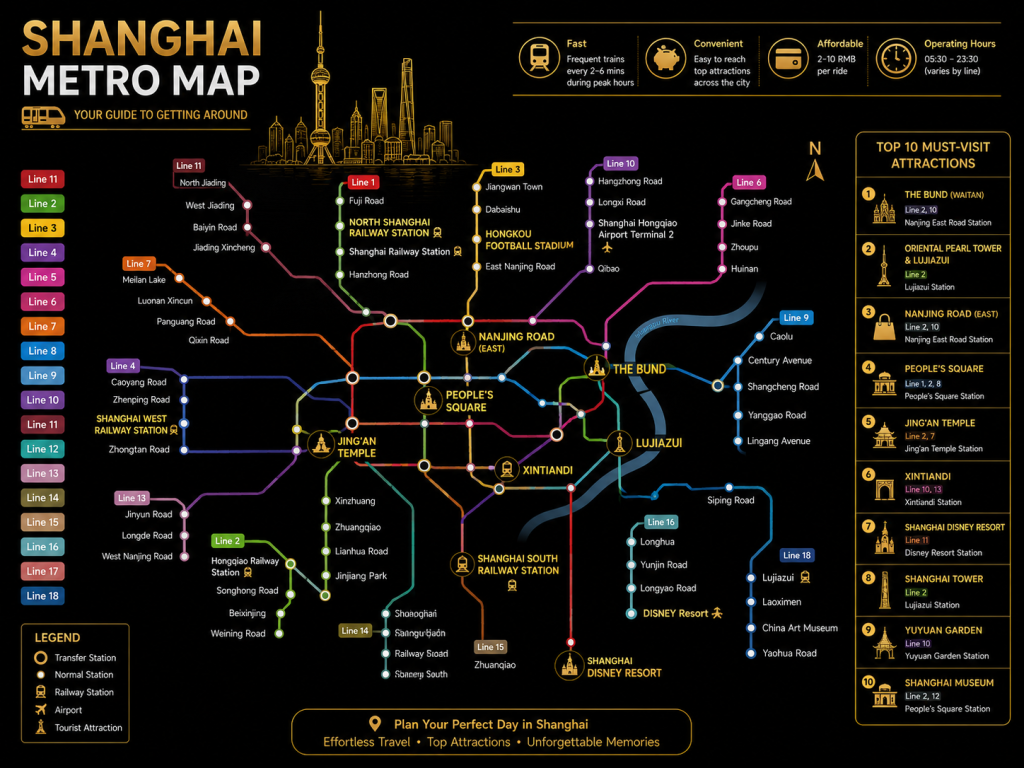
Map Shanghai Metro Map
Why the Shanghai Metro 2026 Is Your Best Friend in the City
The Shanghai Metro is not just a subway — it‘s the backbone of the entire city. As of 2026, the system operates 21 lines with over 500 stations and a total mileage of more than 800 kilometers (about 500 miles). It covers all 16 administrative districts, connecting major commercial centers, tourist attractions, transportation hubs, and residential areas. With an average daily passenger flow of over 10 million, it‘s one of the busiest metro systems in the world.
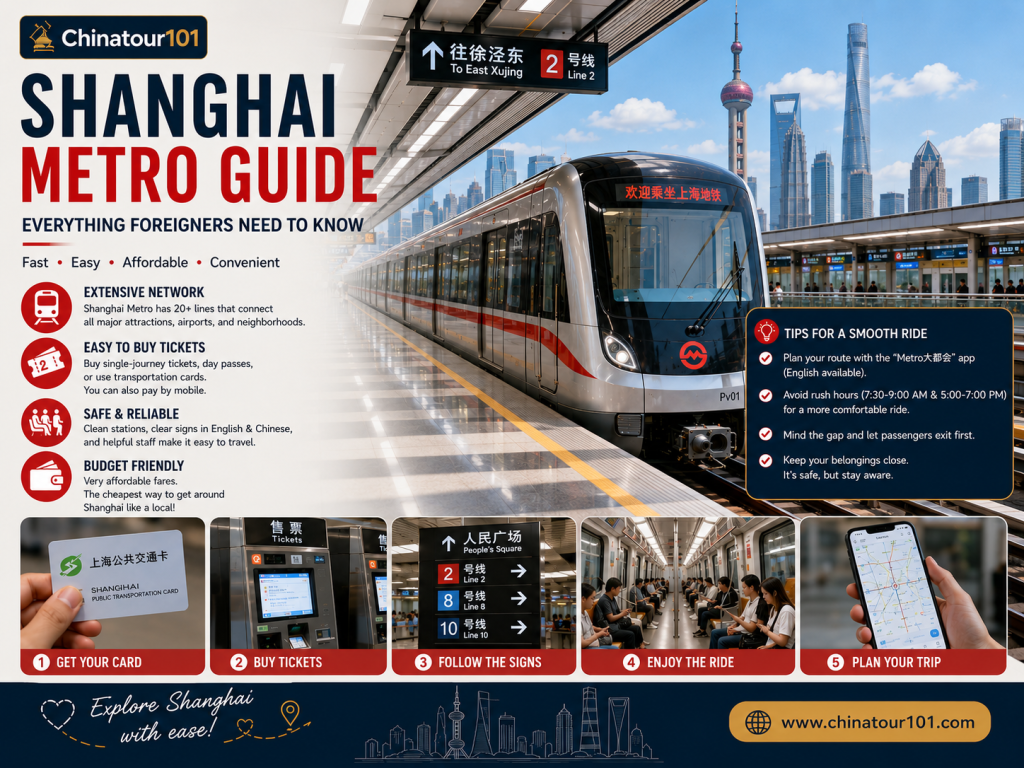
What makes it truly special for travelers is its efficiency and coverage. Main lines like Line 2 and Line 10 connect famous attractions such as the Bund, Yu Garden, Disneyland, as well as the two major international airports (Pudong and Hongqiao) and multiple high-speed rail stations. The system is also foreigner-friendly — signs are bilingual, station announcements are made in both Chinese and English, and ticket machines have an English language option.
I always tell my guests: “The Shanghai Metro is cheaper than a cab, faster during rush hour, and covers almost the entire city”. Once you get the hang of it, you‘ll wonder why you ever considered any other option.
Shanghai Metro Map 2026: Your Essential Companion
The 2026 Shanghai Metro Map is your most important travel tool in the city. It‘s available in both English-Chinese and full English versions. You can find it online, download the official Shanghai Metro app, or pick up a free paper copy at any station service center.
2026 Update: The latest version of the map includes the extensions of Line 2 and Line 18, making previously hard-to-reach areas much more accessible. The city‘s transportation network has seen a “milestone leap” with these new extensions. Keep an eye out for Line 22, which is scheduled to open in 2026, connecting Pudong‘s Jinji Road Station to Chongming District.
The most important lines for tourists in 2026:
- Line 2 (Green) — The most essential line for tourists. Connects Pudong Airport, Lujiazui (Oriental Pearl Tower), People‘s Square, Nanjing Road, and Hongqiao Airport & Railway Station. If it‘s your first time in Shanghai, you‘ll almost certainly use this line the most.
- Line 10 (Purple) — Great for Yu Garden, Xintiandi, the French Concession, and Shanghai Zoo.
- Line 11 (Brown) — The line you‘ll take to Shanghai Disneyland. The stations are even decorated with Disney themes!
- Line 1 (Red) — Runs north-south, stopping at People‘s Square and Xujiahui (a huge shopping area).
Tickets & Payment Methods for Shanghai Metro 2026
🎟️ Single-Journey Tickets
These can be purchased at ticket machines inside stations. Fares are calculated based on distance traveled and generally range between 3 and 15 yuan. The current fare structure (in place since 2005) is: 3 yuan for journeys up to 6km, with an additional 1 yuan for every 10km beyond that.
Important note: As of August 2026, Shanghai is considering its first subway fare increase since 2005. A public hearing is scheduled for September 2026. Keep this in mind when planning your budget.
📱 Mobile Payment (Easiest & Most Convenient)
This is the method I recommend to all my guests. If you have Alipay or WeChat, you can simply open the Shanghai Metro QR code service and scan to enter and exit. It‘s incredibly convenient — no ticket machines, no queues, no fuss. Foreign cards linked to Alipay work much better now than they used to.
Alternatively, download the Shanghai Metro DADUHUI App and link it to your card. I recommend opening the app and generating your QR code ahead of time to avoid congestion and tech problems at the ticket gate.
🚇 Shanghai Public Transportation Card
Perfect for longer stays. You can buy it at metro stations, top it up as needed, and use it on buses too. The deposit is usually around 20 yuan. In urban areas, if you transfer between buses and subways within two hours, you‘ll get a 1 yuan discount. If your monthly subway fare exceeds 70 yuan, the remaining fare for the month is 10% off.
Pro tip: Electronic multi-ride tickets are discounted to 70% of the standard fare, with each ride not falling below the minimum fare of 3 RMB.
🎫 Travel Passes
- One-day Travel Pass: 18 yuan — unlimited metro rides for 24 hours
- Three-day Travel Pass: 45 yuan — unlimited metro rides for 72 hours
- Maglev + Metro Pass: 55 yuan for single maglev trip + 24-hour unlimited metro; 85 yuan for round-trip maglev + 24-hour unlimited metro
⏰ Operating Hours & Frequency for Shanghai Metro 2026
Most lines operate from approximately 5:30 AM to 10:30 PM, though some lines like Line 1 and Line 8 run until midnight.
2026 Update: Starting April 1, 2026, the Airport Link Line adjusted its first and last train times. The first train from Hongqiao Terminal 2 to Pudong Airport now departs at 5:45 AM (15 minutes earlier), and the last train from Pudong to Hongqiao now departs at 10:15 PM (15 minutes later). The system now operates 30 minutes longer per day.
Peak Hours:
- Morning peak: 7:30 AM – 9:30 AM
- Evening peak: 5:00 PM – 7:00 PM
During peak hours in downtown areas, trains arrive every 2-4 minutes. On weekends, trains typically run every 4-12 minutes.
Friday & Saturday extensions: Lines 1, 7, 8, 9, 10 and 13 have extended operating hours on Fridays and Saturdays.
🚉 Major Hubs & Key Stations for Tourists
🏛️ People‘s Square — The Busiest Hub
This is where Lines 1, 2, and 8 meet. Think of it as Shanghai‘s Times Square! It‘s a massive station with dozens of exits and long transfer tunnels. From here, you can visit People‘s Park, the Shanghai Museum, and tons of shopping malls. Taking the correct exit can sometimes save you 15–20 minutes of walking.
🏙️ Xujiahui — Shopping & Electronics Hub
Lines 1, 9, and 11 meet here. It‘s surrounded by huge shopping malls and electronics markets. If you‘re looking for gadgets or want to experience modern Shanghai, this is your stop.
🏯 Yu Garden Station (Line 10) — Old Shanghai
Get off here to see Yu Garden and the beautiful old town area.
🛕 Jing‘an Temple (Lines 2 & 7) — Culture & Luxury
One of Shanghai‘s most famous temples, surrounded by luxury malls.
🌃 Lujiazui (Line 2) — The Postcard View
This is where you‘ll find the Shanghai Tower, Oriental Pearl Tower, and the World Financial Center.
🏰 Shanghai Disneyland (Line 11)
Take Line 11 directly to the Disney Resort station.
❓ FAQ – Shanghai Metro Trip 2026
Q: Is the Shanghai Metro easy to use for someone who doesn‘t speak Chinese?
A: Absolutely — and I say this as someone who has guided hundreds of non-Chinese-speaking travelers through this system. The Shanghai Metro is one of the most foreigner-friendly subway systems in the world. All signs are bilingual (Chinese and English), station announcements are made in both languages, and ticket machines have an English interface. Navigation apps like Gaode Maps have English versions too. I‘ve had 70-year-old grandparents from rural America navigate this system without any problems. The key is to download the right apps, take your time, and don‘t be afraid to ask station staff for help — many speak basic English.
Q: How much does a Shanghai Metro ride cost in 2026?
A: As of August 2026, the fare structure that has been in place since 2005 is still the standard: 3 yuan for journeys up to 6km, with an additional 1 yuan for every 10km beyond that. Most downtown rides cost between 3 and 6 yuan. A trip to Pudong Airport typically costs 7-9 yuan. However, Shanghai is currently considering its first fare increase since 2005, with a public hearing scheduled for September 2026. If you‘re visiting after September, check the latest fares — but even with an increase, the metro will still be far cheaper than taxis.
Q: Which app should I use to navigate the Shanghai Metro?
A: I recommend Gaode Maps as your primary navigation app. It‘s the most accurate and comprehensive for Shanghai. You can use it to plan routes, find the exact exit you need, check travel times, and figure out transfers. For payment, use Alipay or WeChat with the Shanghai Metro QR code function — it‘s the most convenient way to pay. Alternatively, download the official Shanghai Metro DADUHUI App. All three options are reliable and widely used by locals and tourists alike. Download them before you arrive in China.
Q: What should I do if I get lost or confused in a metro station?
A: First, take a deep breath — you‘re not the first person to feel overwhelmed, and you won‘t be the last. Second, look for the English signs — they‘re everywhere. Third, use your navigation app — Gaode Maps will tell you exactly which exit to take. Fourth, ask station staff — many speak basic English, and they‘re used to helping confused tourists. Fifth, if you miss your stop, don‘t panic — just get off at the next station and take the train back. The system is forgiving, and a wrong turn rarely costs you more than a few minutes. I‘ve had guests make mistakes countless times, and they always figure it out. The Shanghai Metro is actually very forgiving — you just have to be patient with yourself.
Shanghai is a city that never stops moving — and the metro is its heartbeat. I‘ve watched travelers arrive in Shanghai intimidated by the size and complexity of the city, and I‘ve watched them leave feeling like they could navigate it blindfolded. The Shanghai Metro is the key to that transformation. It‘s not just a way to get from A to B — it‘s a window into how 25 million people live, work, and move through this incredible city.
I sincerely invite you to come to Shanghai and experience the Shanghai Metro in 2026. Stand on the platform at People‘s Square during rush hour, watch the city‘s rhythm unfold before you, and feel the energy of one of the world‘s greatest cities flowing through its underground veins. This is a journey that will stay with you long after you leave — I promise you that.
If you need any local advice — how to find the right exit at Lujiazui, which line to take to the French Concession, or where to buy a transport card — just ask. I am always happy to share my home with you. Safe travels, and I hope to see you on the Shanghai Metro.

Lila Jiang
She is Lila Jiang, a 28-year-old girl.
With over 10 years in the travel industry, she’s chased wanderlust near and far;
what she loves most is diving into local cultures,
finding hidden gems, and connecting with people who bring journeys to life.
Essential Metro Map Guide
Your Ultimate Guide to the Shanghai Metro Map
Your Ultimate Guide to the Beijing Metro Map
Your Perfect Guide to the Guangzhou Metro Map
Chengdu Metro Trip Guide: Easy Navigation
Essential Shenzhen Metro Trip Guide
Hangzhou Metro Travel Guide: Top Tips
Chongqing Metro Guide: Smooth Trip Tips
Xiamen Metro Trip Guide: Easy to Navigate
Essential Kunming Metro Trip Guide for Visitors
Nanjing Metro Travel Guide: Top Practical Tips
Qingdao Metro Guide: Must-Know Trip Tips
Harbin Metro Travel Guide for a Perfect Trip
Zhengzhou Metro Guide: Essential Trip Tips
Changsha Metro Travel Guide: Smooth Journey Tips
Popular City Travel Guides
Beijing Travel Guide Shanghai Travel Guide Hangzhou Travel Guide Sanya Travel Guide Chongqing Travel Guide
Nanjing Travel Guide Guangzhou Travel Guide ChengduTravel Guide Hongkong Travel Guide Xi’an Travel Guide