
hello, I am Mike Wang, after two decades of helping travelers navigate China, I can tell you one thing with absolute certainty: your smartphone is your most important travel companion in China. China has evolved into one of the world‘s most cashless societies, and if you try to get by with cash and credit cards alone, you’ll find yourself frustrated, confused, and often unable to pay for even a simple cup of coffee.
The good news? 2026 is the most foreigner-friendly year ever for mobile payments in China. Both Alipay and WeChat Pay now allow international travelers to link foreign credit cards directly — no Chinese bank account required. I‘ve personally guided thousands of visitors through this setup, and I’m here to walk you through everything you need to know.
Why You Need Both Alipay and WeChat Pay
Here‘s a piece of advice I give every traveler I work with: install both apps before you leave home. Not one or the other — both.
Alipay is generally more user-friendly for international travelers, with a dedicated “International Version” and smoother foreign card onboarding. WeChat Pay, on the other hand, is deeply integrated into daily Chinese life — it’s how locals chat, order food, book services, and pay for everything from street food to luxury goods.
Some merchants only accept one platform. Having both ensures you‘re never stuck at a checkout counter with a useless app.
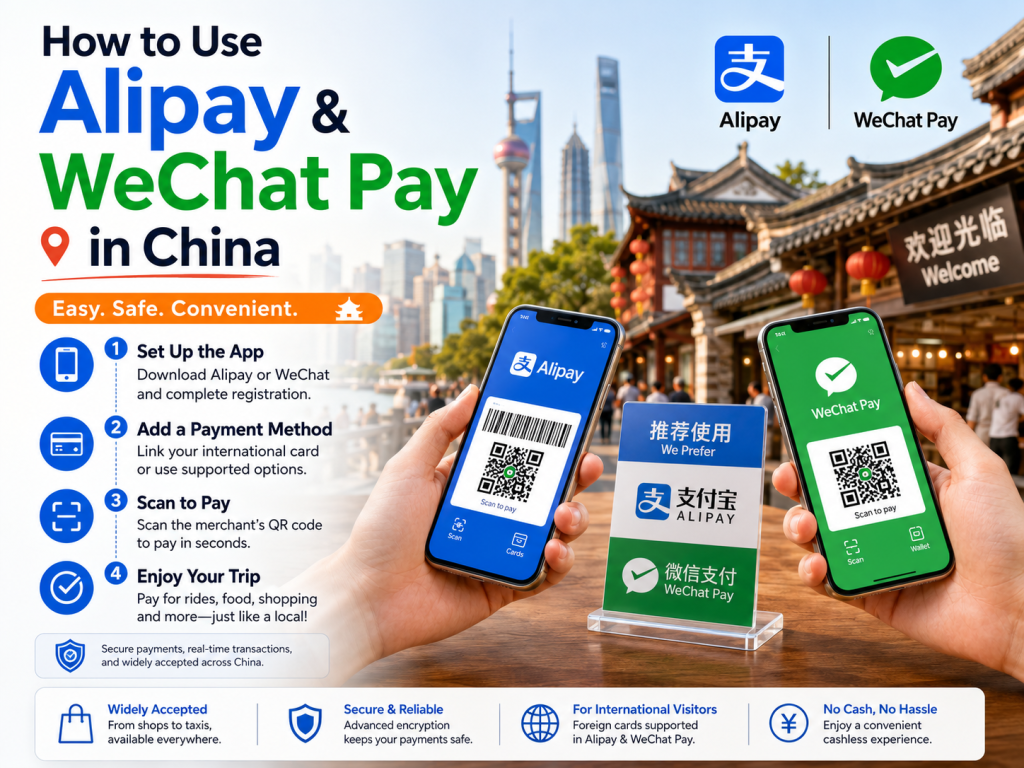
Alipay: Step-by-Step Setup
Alipay is my top recommendation for first-time visitors. Here’s exactly how to set it up:
Step 1: Download the App
Download Alipay from your home country‘s App Store or Google Play before you fly. App Store geo-restrictions inside China can make this surprisingly difficult once you land.
Step 2: Register Your Account
Use your international mobile phone number to create an account. You‘ll receive an SMS verification code — make sure your phone can receive international texts.
Step 3: Complete Identity Verification
Go to “Me” → “Settings” → “Identity Verification.” You‘ll need to upload a clear photo of your passport and complete a quick facial scan. This step is non-negotiable — unverified accounts have severely limited functionality.
Step 4: Link Your International Card
Navigate to “Bank Cards” → “Add Card” and enter your Visa, Mastercard, American Express, JCB, or Discover card details. Alipay raised its single-transaction limit to roughly $5,000 USD for verified passport users in 2026.
Step 5: Start Paying
Once verified, you can pay by scanning a merchant‘s QR code or by showing your own payment code for them to scan.
⚠️Expert Tip: The old Alipay Tour Pass mini-program was retired in 2026. Just use the main app‘s direct card binding — it’s simpler and more reliable.
WeChat Pay: Step-by-Step Setup
WeChat is China‘s “everything app” — messaging, social media, and payments all in one. Setting up WeChat Pay takes a few extra minutes, but it‘s absolutely worth the effort.
Step 1: Download and Install
Download WeChat from your home app store before traveling. The app takes about 1GB of storage space.
Step 2: Create Your Account
Register with your international phone number and complete the basic profile setup.
Step 3: Open WeChat Pay
Go to “Me” → “Services” → “Wallet”.
Step 4: Add Your Card
Select “Add Bank Card” and enter your foreign Visa, Mastercard, or other supported card details. You‘ll need to complete passport-based identity verification with a photo and facial scan.
Step 5: Verify and Start Using
WeChat can be a bit “fussier” than Alipay during verification. Don‘t be surprised if it takes a couple of attempts — do this from home, not from a crowded shop counter.
⚠️Expert Tip: WeChat supports PayPal integration as of 2026, allowing PayPal users (initially from the US) to scan and pay at millions of WeChat Pay merchants across China.
Understanding Fees and Limits (2026 Update)
This is where many travelers get confused. Let me break it down clearly:
The 200 RMB Rule: Both Alipay and WeChat Pay charge a 3% service fee on transactions over 200 RMB when using a foreign card. Transactions under 200 RMB are completely fee-free.
WeChat Pay‘s Special 2026 Promotion: If you‘re a first-time international card user on WeChat, you get 90 consecutive days of fee waivers on daily payments under 1,000 RMB. This is a significant saving for longer trips.
Alipay’s Limits: Verified users have a single-transaction cap of roughly $5,000 USD** and an annual ceiling near **$50,000 USD.
A Word of Caution: Your home bank may also charge foreign transaction fees (usually 1-3%). Using a card with no foreign transaction fees can save you real money on a 10-day trip.
Beyond Payments: Mini-Programs That Will Change Your Trip
Here‘s something most tourist guides don’t tell you: Alipay and WeChat aren‘t just for paying — they’re gateways to hundreds of “mini-programs” that can replace dozens of standalone apps.
Didi Ride-Hailing: Instead of downloading the standalone Didi app, use the Didi mini-program inside Alipay. It offers an English interface and doesn‘t require a Chinese phone number.
Metro and Bus Payments: Most major cities allow you to generate a “Transport Code” within Alipay or WeChat to scan directly at subway turnstiles.
Restaurant Ordering: Scan the QR code on your restaurant table with WeChat to browse the menu, order, and pay — all without speaking a word of Chinese.
Food Delivery & Bookings: Search for Meituan, Ele.me, or Trip.com inside Alipay as mini-programs for food delivery and travel bookings.
Expert Tips From 20 Years of Experience
🌟1. Set up before you fly. This cannot be emphasized enough. SMS verification can be delayed by international roaming, and app stores inside China may not let you download these apps at all.
🌟2. Carry backup cash. While China is overwhelmingly cashless, new regulations effective February 2026 require all merchants to accept RMB cash. Carry 200-500 RMB in small bills for older taxi drivers, rural vendors, or emergencies where your phone battery dies.
🌟3. Keep your phone charged. No battery = no payments. A portable power bank is essential gear for China travel.
🌟4. Consider e-CNY (Digital Yuan). China‘s official central bank digital currency charges zero service fees for transactions and supports offline payments via NFC. You can register with a foreign phone number and top up via international card.
🌟5. Use the same app for entry and exit. If you use a QR code for metro entry, use the same app for exit — mixing Alipay and WeChat will cause problems at the gate.
Frequently Asked Questions
Q: Can I use Alipay or WeChat Pay without a Chinese bank account?
A: Yes — and this is the single biggest change in recent years. In 2026, you can fully verify your identity with your passport and link your home country‘s credit or debit card directly to both apps. No Chinese bank account is required.
Q: What‘s the best payment setup for a short trip?
A: Based on my experience with thousands of travelers, the most reliable setup is: one international credit card linked to both Alipay and WeChat Pay, plus 200-500 RMB in cash as backup. If you’re staying longer than a week, consider the WeChat Pay 90-day fee waiver promotion.
Q: Will my foreign card work everywhere?
A: Most of the time, yes. But foreign cards can occasionally be declined for security reasons — issuer blocks, verification prompts, or merchant settings. This is why I always recommend having two payment methods available. An overseas-issued UnionPay card can be added to both apps and also works directly at terminals across China.
Q: How do I pay for metro and buses with my phone?
A: Most major Chinese cities now allow you to generate a “Transport Code” within Alipay or WeChat. Open the app, find the Transport or City Services section, select your city, activate the code, and scan it at the turnstile. It‘s faster and easier than buying physical tickets.

Mike Wang
Mike Wang is a 40-something Chinese travel expert, has explored the world,
hosting numerous foreign visitors. He’s deeply interested in and knowledgeable
about ancient cultural architectures, enriching journeys with his insights.