
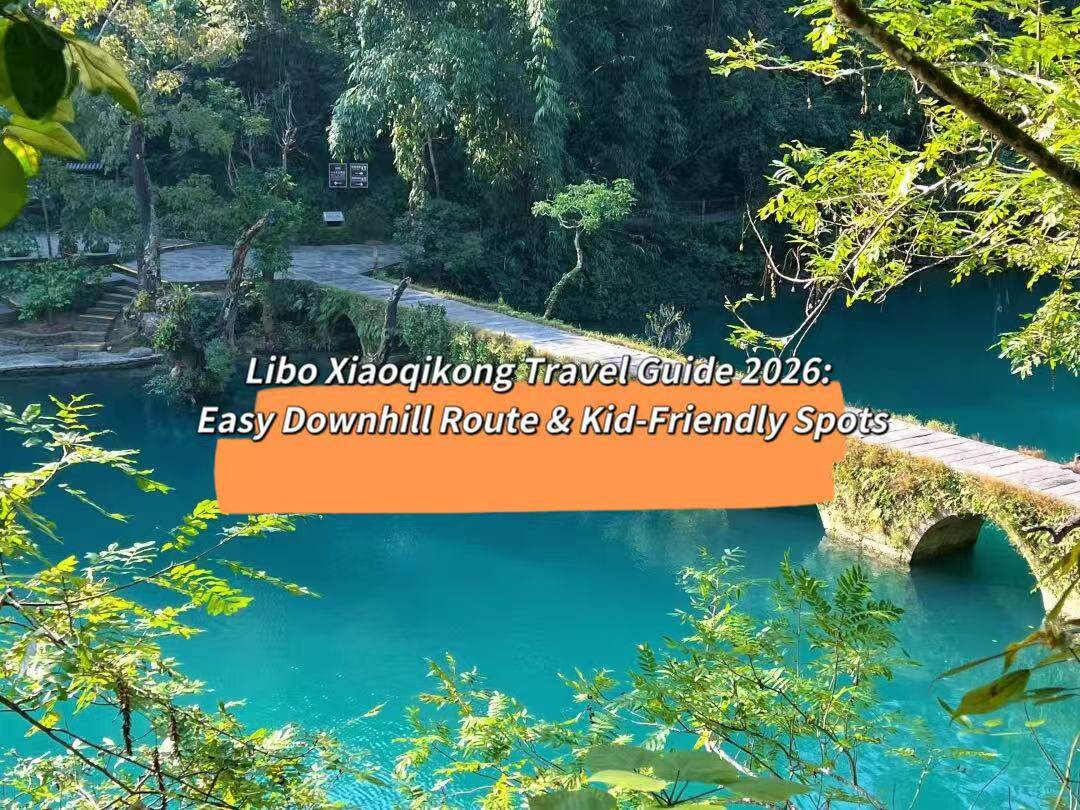
Hello, I’m Mike Wang. For over 20 years, I have guided travelers through China’s most breathtaking landscapes, but few places have moved me as deeply as Libo Xiaoqikong. I still remember my first visit—stepping onto the ancient seven-arch bridge as morning mist drifted over the turquoise water, the sound of cascading waterfalls echoing through the karst valley. I stood there, speechless, and I knew I had discovered something truly extraordinary.
Located in Libo County, Qiannan Prefecture, Guizhou Province, Xiaoqikong is a UNESCO World Natural Heritage site and a core part of the South China Karst. Known as the “Emerald on the Earth’s Belt,” this national 5A-level scenic area stretches about 7 kilometers through a narrow valley, combining mountains, water, forests, caves, and waterfalls into one spectacular landscape. The park takes its name from the Qing Dynasty seven-arch stone bridge built in 1836, which still stands gracefully over the Xiangshui River. If you are planning your Guizhou trip 2026, this Libo Xiaoqikong travel guide 2026 will give you everything you need—from the iconic ancient bridge to the Tiffany-blue waters of Wolong Pool, from the 68-tier waterfall to the enchanting Water Forest. Let me share what I’ve learned from two decades of bringing travelers to this emerald paradise.
💚 Why Libo Xiaoqikong 2026 Belongs on Your China Bucket List
You might be thinking, “Another scenic area in China?” But Xiaoqikong is genuinely in a league of its own.
First, the water is unlike anything you’ve ever seen. The color is a surreal Tiffany blue—so vivid that first-time visitors often think it’s Photoshopped. I’ve watched seasoned travelers stand at the edge of Wolong Pool, silent, trying to comprehend the color. One honest truth I’ve learned: “When making the guide, I thought ‘Tiffany blue‘ was just a filter. Only when I arrived did I realize—some colors can’t be captured by a phone”. The water is at its most spectacular two days after rain, when the sediment settles and the emerald hues emerge in full force.
Second, the diversity is extraordinary. In a single day, you can walk across a 200-year-old stone bridge, feel the spray of a 30-meter waterfall, wade through a forest where water flows over stones and trees grow in water, and gaze at a crescent-shaped pool that looks like it belongs in a fairy tale. The scenic area packs more variety into 7 kilometers than most parks do into 70.
Third, the accessibility is remarkable. With a well-designed sightseeing bus system and a route that can be entirely downhill if you enter from the West Gate, Xiaoqikong is one of the most effortless yet rewarding scenic areas in all of China. Whether you’re a seasoned hiker, a family with young children, or a senior traveler, you can experience the full majesty of this place without exhausting yourself.
I’ve taken travelers from all over the world to this park, and the reaction is always the same: disbelief, followed by gratitude. This place doesn’t just show you beauty—it immerses you in it.
🎟️ Tickets, Hours & Smart Booking for Libo Xiaoqikong 2026
💰 Ticket Prices (2026 Update):
| Item | Peak Season (Mar–Nov) | Off Season (Dec–Feb) |
|---|---|---|
| Admission | 120 RMB | 80 RMB |
| Sightseeing bus (mandatory) | 40 RMB | 40 RMB |
| Total | 160 RMB | 120 RMB |
Free admission (sightseeing bus 40 RMB self-paid): children under 6, seniors 65+, teachers, military personnel, medical staff, and students.
⏰ Opening Hours (2026):
- Peak Season (March–November): 7:30 AM – 5:30 PM
- Off Season (December–February): 8:00 AM – 5:00 PM
- Last entry: 4:30 PM
⚠️ Important 2026 Notice:
After a period of closure, the scenic area fully reopened from July 20, 2026. The park now operates with a daily capacity limit of 10,000 visitors. Real-name reservation is required 5–7 days in advance through the (One-Code Tour Guizhou) mini-program or the official WeChat account. Tickets are valid for 2 days with unlimited re-entry.
🚗 How to Get to Libo Xiaoqikong 2026
🚄 By High-Speed Rail (Recommended – Easiest & Fastest):
This is by far the most convenient way to reach Xiaoqikong.
- Take the high-speed train from Guiyang North Station to Libo Station—about 1 hour, approximately 100 RMB
- From Guiyang Station to Libo: about 1 hour 10 minutes, approximately 91 RMB
- After exiting Libo Station, take Bus No. 11 (5 RMB) or the direct shuttle bus (10–35 RMB) to the scenic area’s East Gate
🚗 Self-Driving:
- Navigate to Libo Xiaoqikong Scenic Area East Gate or West Gate
- From Guiyang: about 2.5 hours direct
- Parking fee: 30 RMB per day
🚌 From Libo County:
- Direct buses run from Libo County to the scenic area
- Taxis and ride-hailing services are also available
🚠 Within the Scenic Area:
- The sightseeing bus is mandatory—attractions are spread over 7 kilometers, and walking between them would take hours
- The bus connects all major attractions and runs frequently
- The smartest route: Enter from the West Gate, exit from the East Gate—this is entirely downhill, saving your legs and your energy
💎 The Main Attractions: What to See in Libo Xiaoqikong 2026
🌊 Wolong Pool – The Crown Jewel of Xiaoqikong
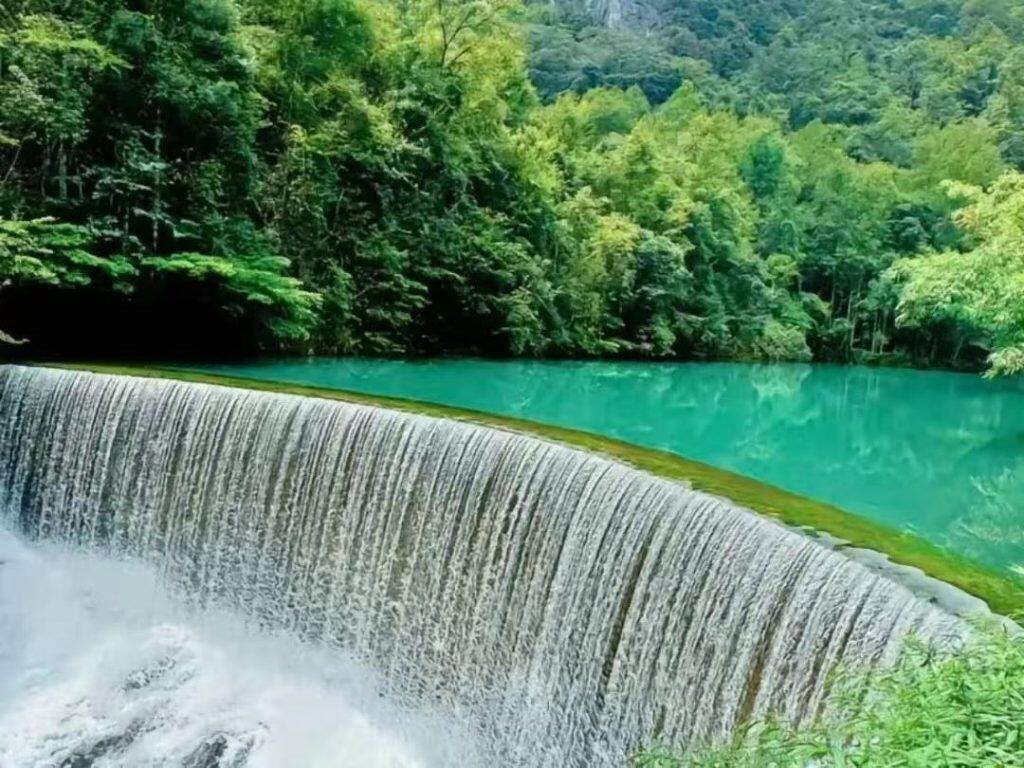
Wolong Pool is the most photographed spot in the entire scenic area—and for good reason. Hidden in dense mountain woods, this stunning pool displays rich layers of Tiffany blue that seem almost unreal. A crescent-shaped small waterfall gently falls at one end, and a faint mist lingers over the water year-round, creating a tranquil, dreamy atmosphere. Surrounded by green mountains and towering ancient trees, the reflection of mountains and water blends in the pool, peaceful and serene.
What makes it special: The water is so clear you can see the pebbles at the bottom. On sunny afternoons after 3 PM, the pool shows a Tiffany blue gradient that is simply breathtaking. This is the “beauty standard” of Xiaoqikong—the image that defines the entire park.
Pro tip: Visit in the morning for the best reflections from the viewing platform. The pool is most beautiful two days after rain when the water is at its clearest and most vivid.
🌉 Xiaoqikong Ancient Bridge – The Iconic Landmark
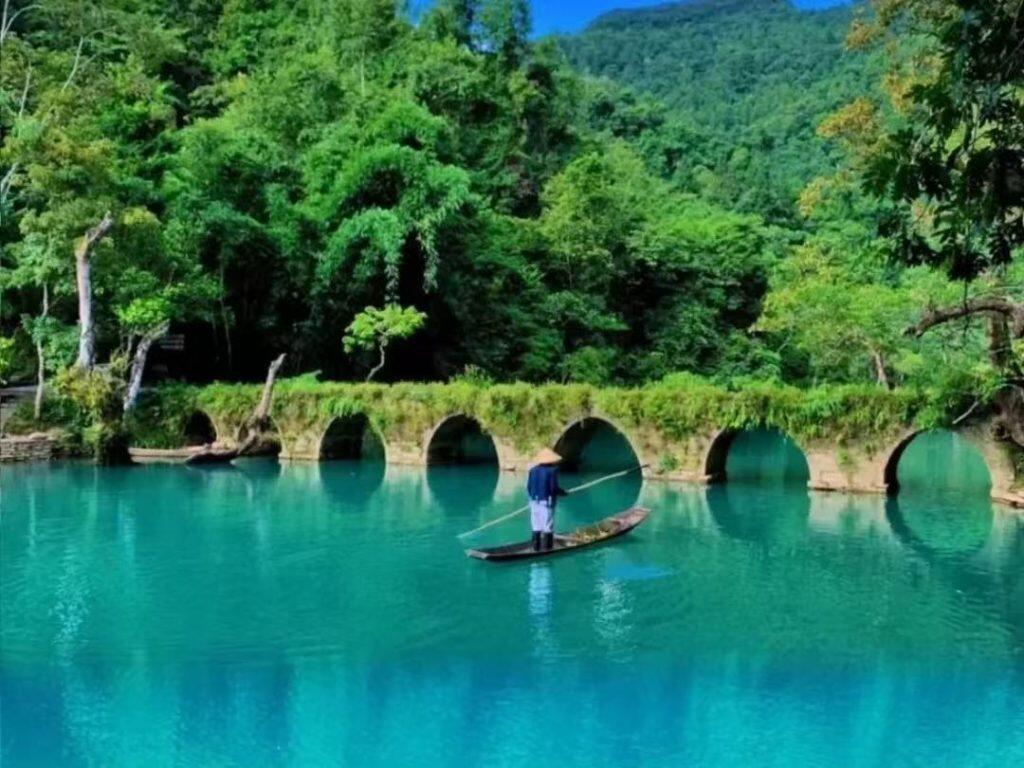
The Xiaoqikong Ancient Bridge is the heart and soul of the park. Built in 1836 during the Daoguang era of the Qing Dynasty, this seven-arch bluestone bridge has stood for nearly 200 years. Vines grow freely along the bridge, moss covers the stones, and the clear emerald water flows peacefully beneath.
What makes it special: In the early morning, mist drifts over the river, and the ancient bridge reflects in the clear water, blending reality and illusion poetically. The bridge is not just a photo spot—it’s a living piece of history that has witnessed nearly two centuries of change.
Pro tip: The softest light is in the early morning (before 7:30 AM) or evening. Shoot from the stone steps on the east side of the bridge to avoid crowds. The mossy bridge body contrasting with the clear water creates an atmosphere that’s simply divine.
🌊 68-Tier Cascading Waterfall – A Living Landscape Painting
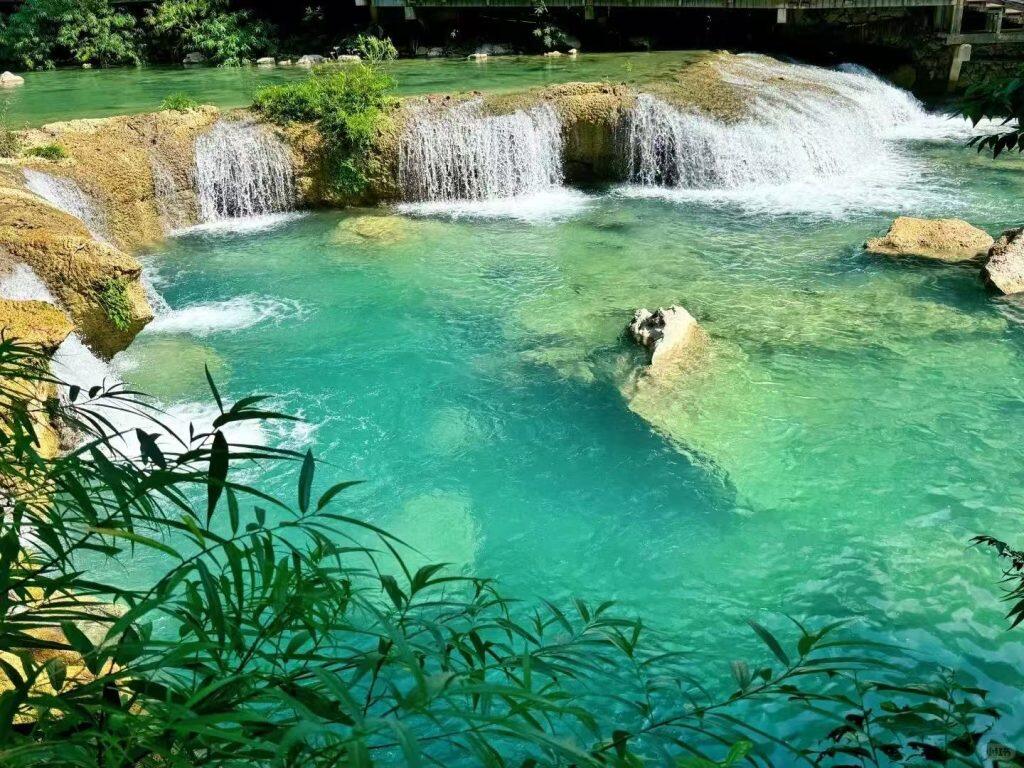
The 68-Tier Cascading Waterfall is a marvel of nature’s craftsmanship—a 1.6-kilometer stretch of travertine waterfalls that tumble down the mountain in staggered layers. Along this hundred-meter river channel, water crashes against green stones, splashing fine white waves in a lively, continuous rhythm.
What makes it special: The sound of flowing water is crisp and pleasant, and the breeze carries mist that cools the air. Walking here feels like moving through a flowing landscape painting. During the rainy season, you can often see rainbows forming in the mist.
Pro tip: This stretch takes about 1 hour to walk. The path follows the water downhill—every step offers a new perspective. This is the most stunning stop on the entire route.
💧 Laya Waterfall – The “Beautiful Goddess” of Xiaoqikong
Laya Waterfall is a spectacular 30-meter-high, 10-meter-wide cascade that plunges dramatically from the cliff face. The name “Laya” comes from the Bouyei language and means “beautiful goddess”—and true to its name, the waterfall cascades like a goddess’s hair falling down the mountain.
What makes it special: What makes this waterfall unique is that it falls right next to the walkway—you can feel the mist on your face and the temperature drop several degrees as you pass. The water, over twenty meters wide, plunges from the cliff with mist flying everywhere. On sunny days, faint rainbows often appear.
Pro tip: This is a 20-minute stop. Stand near the waterfall and let the mist cool you down—it’s the perfect refreshment on a hot summer day.
🌿 Water Forest – A Unique World Where Water Flows Over Stones
The Water Forest is one of the most unique and playful experiences in Xiaoqikong. This 1.2-kilometer stretch features the extraordinary phenomenon of “water flowing over stones, trees growing in water”. Ancient trees with roots tangled and anchored in the water stand firm, while clear streams flow over green stone shallows.
What makes it special: Visitors can walk along stone paths with water flowing over them, feeling the cool stream rush over their ankles. The experience is refreshing, playful, and deeply connected to nature. The negative ion count here is through the roof—it’s an oxygen bar for your lungs.
Pro tip: Wear creek shoes or waterproof sandals—your feet will get wet. The Water Forest takes about 40 minutes to walk. Bring a waterproof bag for your phone and valuables.
🏞️ Cuigu Waterfall – A Kid-Friendly Water Play Paradise
Cuigu Waterfall is a approximately 40-meter waterfall set in a valley surrounded by mountains. What makes this spot special is the shallow water area at its base where visitors can play and cool off.
What makes it special: This is the perfect spot for families with children—kids can safely splash in the water while parents relax and take in the view. The waterfall itself looks like a “white ribbon” hanging on the mountainside.
Pro tip: This is a 30-minute stop. Take off your shoes and step into the water to cool down instantly. Stand on the viewing platform for a panoramic shot that will make your friends ask where you are.
🛶 Mandarin Duck Lake – A Hidden Water Maze
Mandarin Duck Lake (Yuan Yang Hu) is a hidden water maze surrounded by dense forest. The lake is covered with lush vegetation, creating a peaceful, shady atmosphere that feels like a secret world.
What makes it special: You can rent a transparent boat for 50 RMB for unlimited time and paddle through the water maze, weaving between trees and exploring hidden corners. It’s a silent, immersive experience—perfect for couples, friends, or anyone seeking tranquility.
Pro tip: This takes about 1 hour. The lake is most beautiful in the morning when the light filters through the trees.
🗺️ Sample Itineraries for Libo Xiaoqikong 2026
🌅 The Smart One-Day Route (Recommended – West Gate Entry, East Gate Exit)
Route: West Gate → Wolong Pool (45 min) → Mandarin Duck Lake (1 hour, optional boat) → Cuigu Waterfall (30 min) → Water Forest (40 min) → 68-Tier Cascading Waterfall (1 hour) → Laya Waterfall (20 min) → Xiaoqikong Ancient Bridge (30 min) → East Gate
Why this route: Entering from the West Gate and exiting from the East Gate means you are walking entirely downhill—this is the effortless way that 90% of smart travelers choose. The sightseeing bus takes you to each stop, and you walk the scenic sections between them.
🌄 The Photographer’s Route (For sunrise and golden hour chasers)
- Before 7:30 AM: Enter the park and head straight to Wolong Pool or Xiaoqikong Ancient Bridge for empty, misty shots
- Mid-morning: Follow the standard route downhill
- Afternoon: Return to Wolong Pool after 3 PM for the Tiffany blue gradient
- Evening: End at the Ancient Bridge for soft evening light
👨👩👧👦 The Family-Friendly Route (With young children)
Focus on the most accessible and playful spots: Cuigu Waterfall (water play), Water Forest (wading), and Xiaoqikong Ancient Bridge (easy walking). Skip Mandarin Duck Lake if boat rides aren’t suitable. Allow 4–5 hours and take plenty of breaks.
💡 Local Expert Tips for Libo Xiaoqikong 2026
After countless visits, here are my golden rules:
- Book tickets 5–7 days in advance — with the 10,000 daily visitor limit, this is non-negotiable
- Enter from the West Gate, exit from the East Gate — it’s all downhill, saving your legs and your energy
- Enter before 7:30 AM — beat the tour groups and have the ancient bridge and Wolong Pool to yourself
- Wear creek shoes or waterproof sandals — the Water Forest means wet feet
- Bring a light jacket — the mountains are cooler than the valley
- Don’t wear white shoes — the red soil and wet paths will stain them
- Bring your own snacks — park bottled water is 8 yuan, beef noodles are 32 yuan
- Don’t go right after heavy rain — the river water is muddy. The water is greenest 2 days after rain
- Bring your original physical ID — discount tickets require verification
- Wear light-colored clothing — it contrasts beautifully with the emerald water
- Bring rain gear — mountain weather is unpredictable; a raincoat is better than an umbrella
- The best seasons are April–June (water volume explodes, waterfalls are spectacular) and September–October (clear water, beautiful scenery, fewer crowds)
❓ FAQ – Libo Xiaoqikong Trip 2026
Q: Is Libo Xiaoqikong worth visiting if I’ve already been to Jiuzhaigou?
A: Absolutely—and I say this as someone who has brought hundreds of visitors to both places. While Jiuzhaigou is famous for its colorful lakes, Xiaoqikong offers a completely different experience. The water here is a vivid Tiffany blue that you won’t see anywhere else. The landscape is more compact and accessible—you can experience the full majesty of the park in 3–5 hours without exhausting yourself. The 68-tier cascading waterfall, the Water Forest where you walk through flowing water, and the intimate feel of the ancient bridge surrounded by karst peaks create an experience that is uniquely Xiaoqikong. Many of my guests have told me they actually prefer Xiaoqikong because it feels more intimate and less crowded than Jiuzhaigou. It’s not about which is better—it’s about experiencing two different kinds of beauty. I recommend visiting both if you have the time.
Q: Can I visit Libo Xiaoqikong as a day trip from Guiyang?
A: Yes—and it’s one of the most popular day trips from Guiyang. The high-speed train from Guiyang to Libo takes just 1 hour. From Libo Station, the shuttle bus to the scenic area takes about 15–20 minutes. If you enter from the West Gate and exit from the East Gate, you can complete the full route in 3–5 hours. Start early (catch the 7:00–8:00 AM train from Guiyang), and you’ll be back in Guiyang by evening. However, I recommend staying at least one night if you can—the park is most magical in the early morning before the crowds arrive, and staying overnight allows you to experience that magic without rushing.
Q: Is Libo Xiaoqikong suitable for elderly visitors or families with young children?
A: Yes—and it’s one of the most accessible major scenic areas in China. The key is to enter from the West Gate and exit from the East Gate—this means the entire route is downhill. The sightseeing bus takes you between the major stops, and the walking sections are well-paved and manageable. The Water Forest involves walking through shallow water, but there is a dry path alongside it for those who prefer to stay dry. Cuigu Waterfall has a kid-friendly water play area that children absolutely love. Seniors 60+ get free admission and only need to pay for the sightseeing bus. I’ve taken elderly guests and families with young children here many times, and they’ve all had wonderful experiences. Just take it slow, bring plenty of water, and enjoy the journey.
Q: What’s the best month to visit Libo Xiaoqikong in 2026 for the most spectacular water views?
A: For the most spectacular waterfalls, visit in April–June when the water volume is at its peak. The 68-tier waterfall and Laya Waterfall are at their most dramatic during this period. For the clearest, most vivid emerald water, visit in September–October when the weather is stable, the water is clear, and the crowds are thinner. The water is actually at its greenest two days after rain—the rain washes sediment into the river, but by the second day, the water has cleared and the emerald hues emerge in full force. I personally recommend late September to mid-October—the weather is perfect, the water is stunning, and you avoid the summer crowds.
Libo Xiaoqikong is more than just a scenic area—it is a place of healing, wonder, and quiet joy. For nearly two centuries, the ancient bridge has stood over the Xiangshui River, watching the seasons change and the world transform around it. The water that flows through this valley has been carving its way through the karst for millions of years, creating one of the most beautiful landscapes on Earth.
I have watched travelers arrive in Xiaoqikong stressed and exhausted from the chaos of modern life, and I have watched them leave with peace in their eyes and a smile on their face. There is something about the Tiffany blue water, the sound of cascading waterfalls, and the cool mist on your face that resets something deep inside you. This is a place that reminds you of the simple, profound beauty of the natural world.
I sincerely invite you to come to Guizhou and experience Libo Xiaoqikong in 2026. Walk across the ancient seven-arch bridge at sunrise, feel the spray of Laya Waterfall on your face, wade through the Water Forest, and let the emerald waters of Wolong Pool take your breath away. This is a place that will stay with you long after you leave—I promise you that.
If you need any local advice—where to find the best sour soup beef, how to navigate the new reservation system, or which viewpoint offers the most stunning photo—just ask. I am always happy to share my home with you. Safe travels, and I hope to see you in Libo.

Mike Wang
Mike Wang is a 40-something Chinese travel expert, has explored the world,
hosting numerous foreign visitors. He’s deeply interested in and knowledgeable
about ancient cultural architectures, enriching journeys with his insights.
Essential China Attractions
Zhangjiajie Travel Guide 2026: Complete Guide to China’s Most Spectacular Natural Wonder
Jiuzhaigou Travel Guide 2026: Complete Guide to China’s Fairyland
Huangshan Travel Guide 2026: Yellow Mountain Complete Guide
Yangshuo Guangxi 2026 | Karst Mountains & Li River Paradise
Potala Palace Travel Guide 2026: Lhasa’s Iconic Tibet Landmark & Top Attractions
Suzhou Classical Gardens 2026 | UNESCO World Heritage Guide
Dunhuang Mogao Caves Travel Guide 2026: Complete Visitor’s Manual
Zhangye Danxia Travel Guide 2026 | China’s Rainbow Hills
Lijiang Ancient Town 2026 | UNESCO Naxi Cultural Gem Guide
Qinghai Lake Travel Guide 2026: China’s Largest Salt Lake – Complete Local Tips
Xishuangbanna Travel Guide 2026 | Borderland Tropical Paradise China Summer Escape Pick
2026 Wuzhen Trip – East & West Gate Iconic Yangtze Delta China Attraction
2026 Shaolin Temple Trip – World-Famous Zen Temple Top China Attraction
Hukou Waterfall Travel Guide 2026 | Yellow River’s Grand Roaring Falls Guide
Changbai Mountain Tianchi Travel Guide2026 | China’s Volcanic Alpine Lake Guide
Danxiashan Travel Guide 2026 | China’s Colorful Danxia Landform Gem Guide
Fujian Tulou Travel Guide 2026 | UNESCO Ancient Hakka Earthen Building Guide
| Updated: July 20, 2026Popular City Travel Guides
Beijing Travel Guide Shanghai Travel Guide Hangzhou Travel Guide Sanya Travel Guide Chongqing Travel Guide
Nanjing Travel Guide Guangzhou Travel Guide ChengduTravel Guide Hongkong Travel Guide Xi’an Travel Guide